I recently went through a box of old stationery related items that have been accumulating for a long time. It was time to do it, since I’ve been trying to get things more organized (and downsized) post-move. I knew the general variety of things I would find – stacks of post-it notes, random bits and bobs such as clips, push-pins, and spare erasers, and a whole bunch of pens and pencils (some markers too!).
Amongst this vein of stationery goodness, I found three boxes of staples that I’ve had since the 5th or 6th grade, a small box of paper clips that I’ve had a similar amount of time, and some old mechanical pencils!
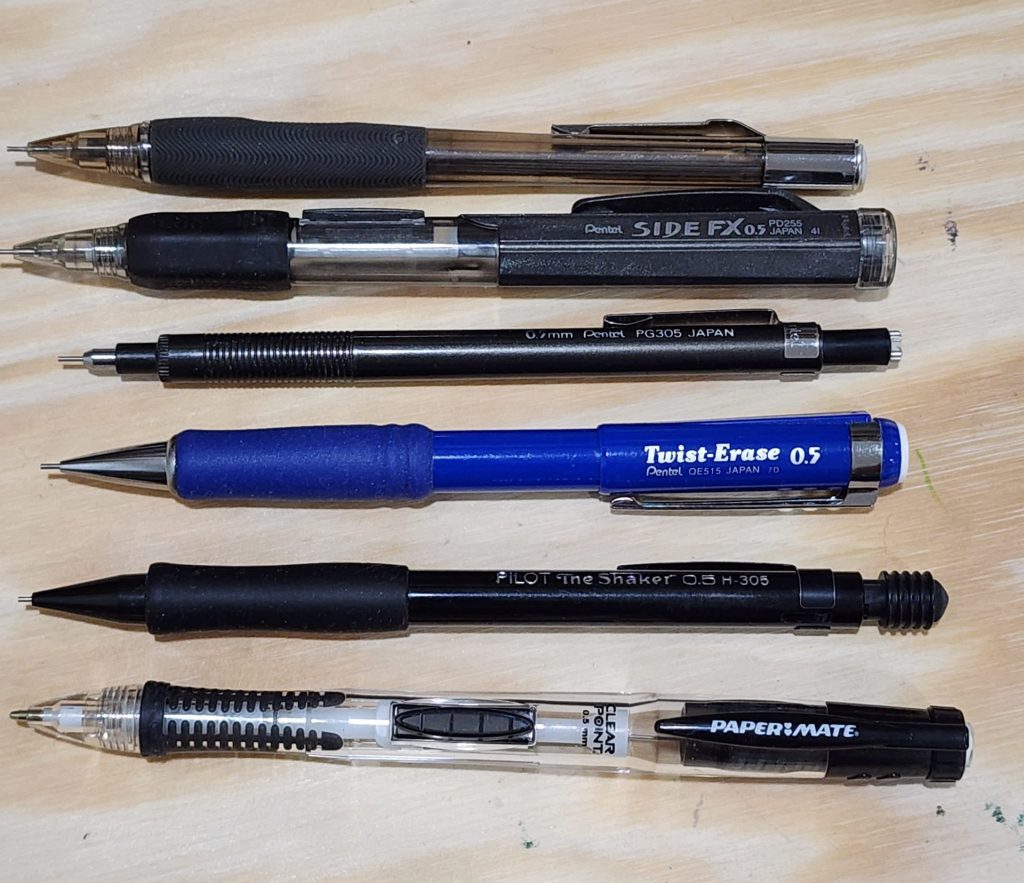
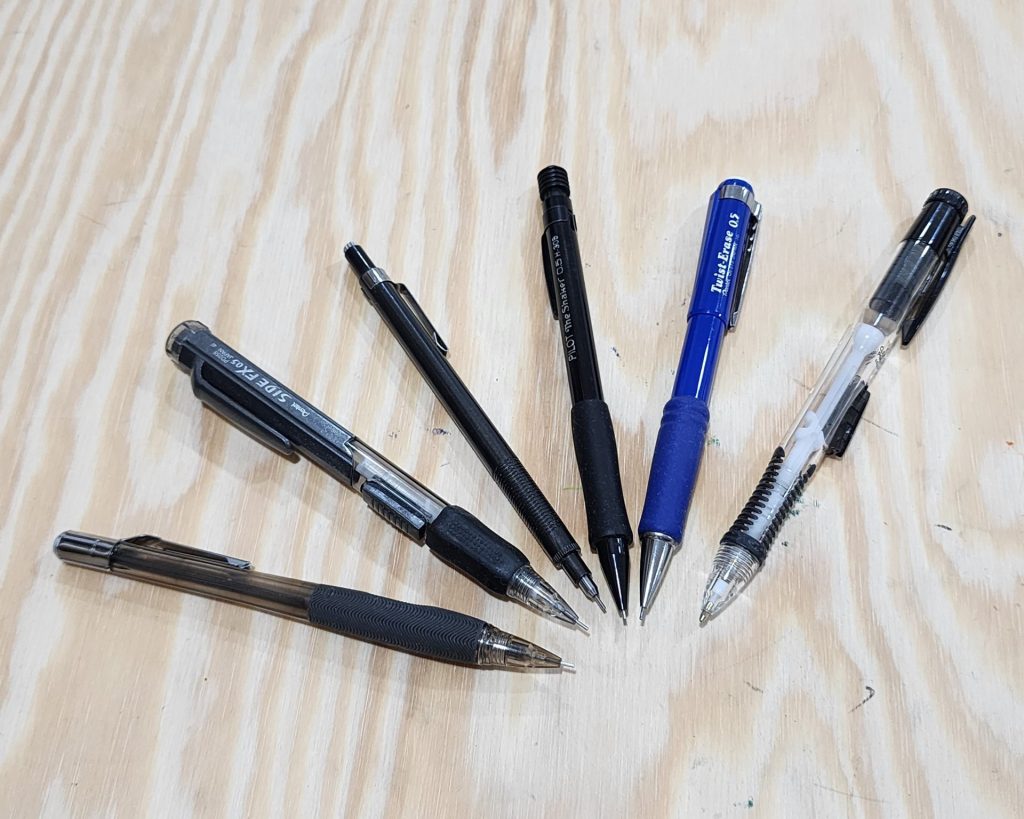
Most of these probably joined my collection between the 8th – 10th grade timeframe (except that Paper Mate, it was probably an early college acquisition), and most have seen quite a bit of use! Some of them were definitely purchased by parents, others seem like they’ve just always been there.
Those that had eraser caps are long gone, victims of a time when backpacks had one large compartment and it held everything one might need at school. These are also all 0.5mm pencils, because 0.3mm was effectively unheard of where I grew up, and 0.7mm was too wide for my liking.
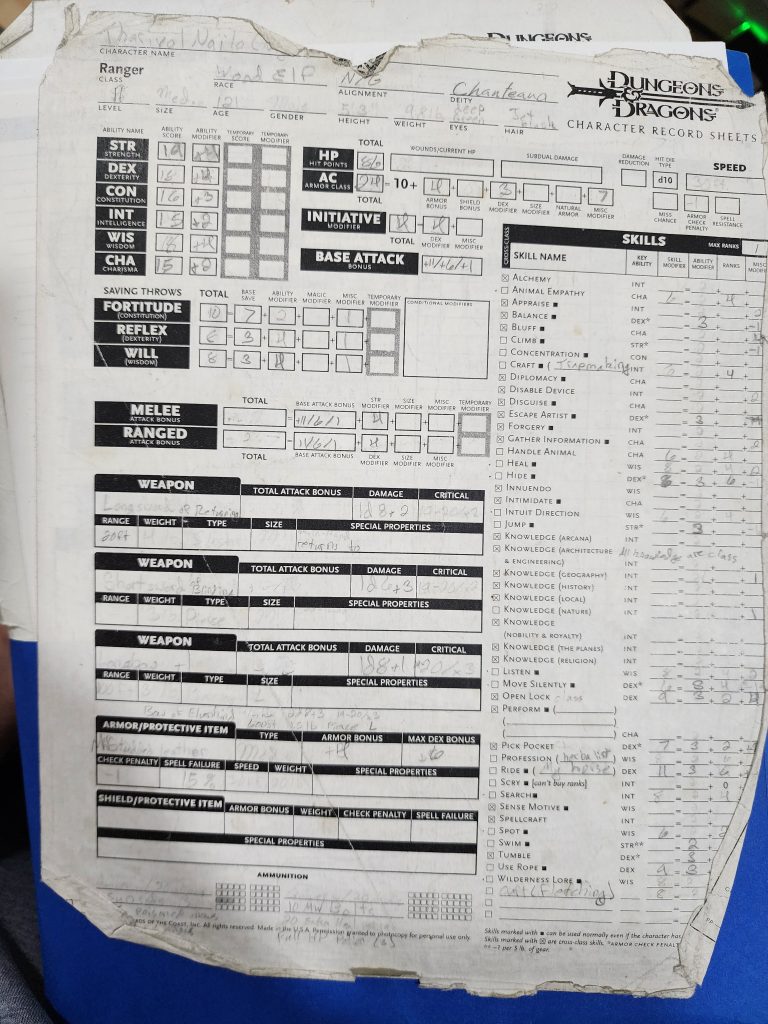
Some of these pencils took me through my first days of D&D campaigning with friends, where no one really knew what they were doing but we were all having a great time!
Amazed I still have this, and that more of the writing hasn’t worn off. It’s been sitting in what was definitely my Spanish-class-turned-RPG-paper-storage folder.
Pentel PD345 Quicker Clicker
These used to (maybe they still do), come in packs of 3. This is the only one I still have, and I don’t have any spare erasers either. I remember that being one of the biggest drawbacks to me, was that the erasers would run down quick, and then you would have to carry one of those pink bricks that somehow always ended up with wooden pencils stabbed into them.
One of the benefits of this mechanical pencil, though, was the volume of lead it could carry. I don’t ever recall running out of lead, and I would never remember adding any more. It just seemed to have an infinite supply. Even as I found it, it held no less than 10 sticks of (presumably HB) lead ready to go.
Pentel PD255 Side FX
I recall using the Pentel Side FX pretty heavily in high school. It’s body is a lot wider than most standard wooden pencils and even the more commonly available mechanical pencils at the time. I think the more geometric barrel shape is what really drew me to it, along with the easy-to-press lead extension button on the side. Being able to extend the lead with minimal change to my grip was nice.
This was the pencil I would usually carry with me at lunch, up to the same table my friends would always claim, and we would ramble on for 45 minutes playing 3e or just some random game that someone made up. It was definitely a nostalgic find.
Pentel PG305
The PG305 is actually one I don’t think I used that much. It was too narrow for my tastes back then, and I wasn’t a fan of the eraser refill. Where did it come from and how did it get into this collection then? We’ll never know.
Pilot H-305 The Shaker
“The Shaker” sounds like a class option out of Pine Shallows or Kids On Bikes 2e. This mechanical pencil definitely shook things up back in the day, too. You can aggressively swing your hand around in class and not get in trouble? Well, probably only once…
I haven’t tried any of the newer versions of The Shaker, but what I like about this one is the heft of the weight inside the lead extension mechanism. It adds some extra weight to the pencil overall, and for some reason I’ve always liked having a heavier writing instrument in hand. I am concerned that should it break, it’s something that will never be repairable, and that heavy weight shifting around inside all the time seems like a recipe for heartbreak.
Pentel QE515 Twist-Erase
This was another mechanical pencil I recall using quite a bit. After losing all the eraser caps of my other pencils, then dealing with things like erasers getting pulled out of them or prematurely wearing down due to constant friction against books and whatever else was in my bag. Having a mechanism to hide my eraser until it was needed, and it wouldn’t simply fall off of the back (looking at you eraser caps), was a welcome change.
Paper Mate Clear Point
While I don’t believe this one is as old as the others, I’m pretty sure I picked it up because it had similar mechanical functions. Side-click lead extension? Check. Twistable eraser I can retract and not break or crush? Yep. Comfortable grip? Debatable, but yeah, it’s not bad.
This one definitely hasn’t had as many miles put on it as the others in this list, and a good deal of that is from the fact that most of my college days moved towards video games rather than TTRPG’s.
So yep, there’s a long post about a handful of pencils I found in a box. They now live in a small pencil box, in a drawer, on my newly organized table space, where I hope to start getting more time to play some solo RPG’s. Hopefully that means some of these make it into the rotation as well.
If you don’t have a favorite pencil, hopefully this can inspire you to find something you really enjoy writing with for your next Pen and Paper Quest!
What do you do when you’re out and about, and have a sudden desire to play a game? Or maybe you just find yourself with 10 minutes before your next meeting or before you have to run your next errand.
Sure, it’s easy to pull out a phone (something I am still guilty of), but I stare at enough screens all day that I feel like I need a break most of the time. So, I started carrying around a handful of different things that could get me into an analogue mood.
While the items within my kit may change, or rotate in and out, generally speaking it’s still the same. Sometimes it will have a fountain pen, other times it may have an extra “pocket game”, or if I’m really into a particular ruleset, it may cater to that particular game I’m playing. Now let’s dive into the details!
Nock Co Hightower case in coffee brownNock Co Hightower case interior in amethyst purple
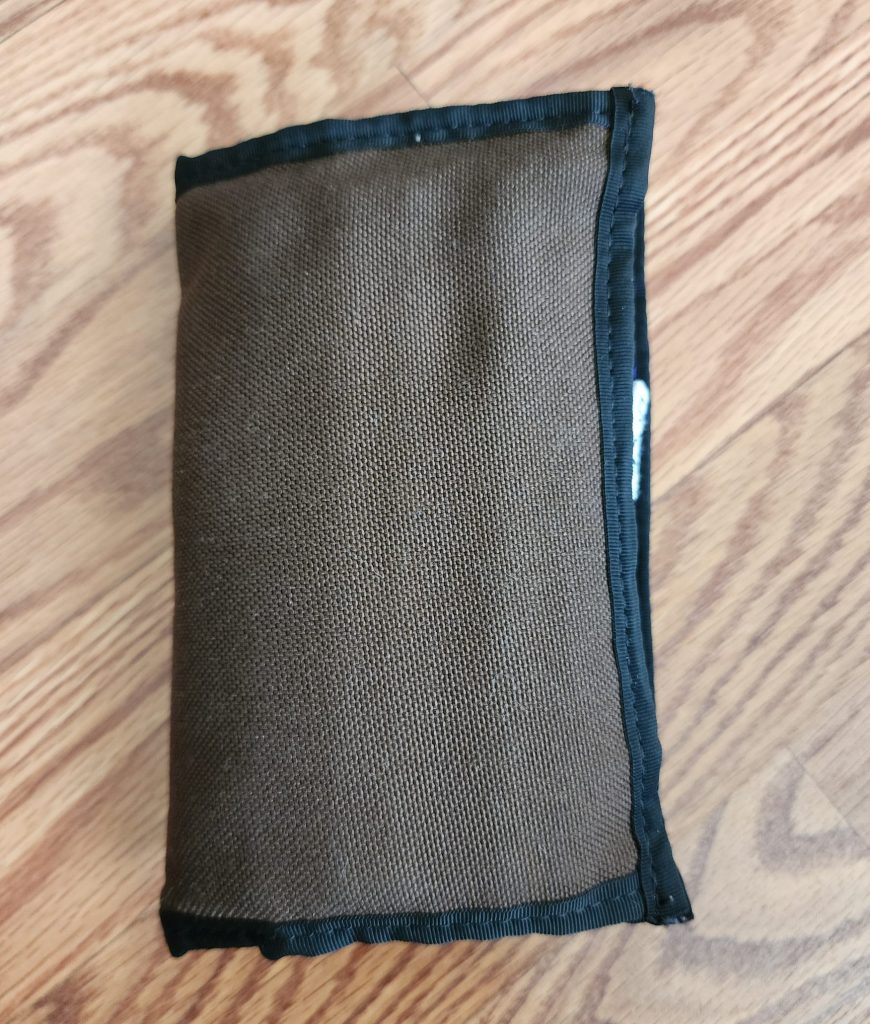
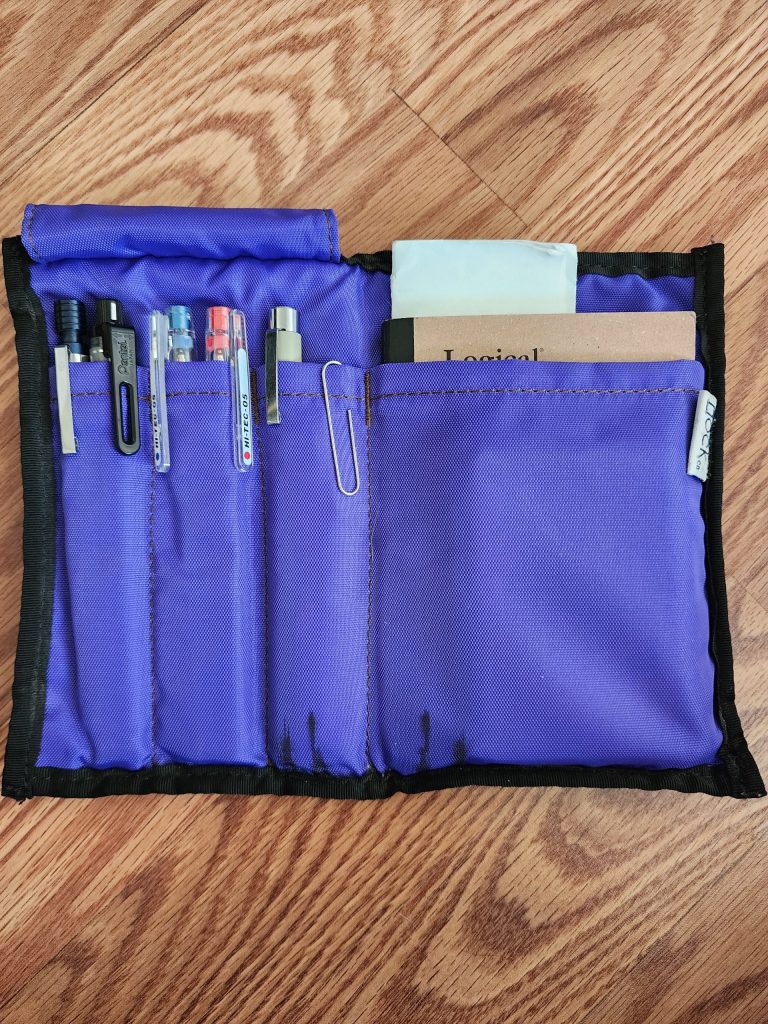
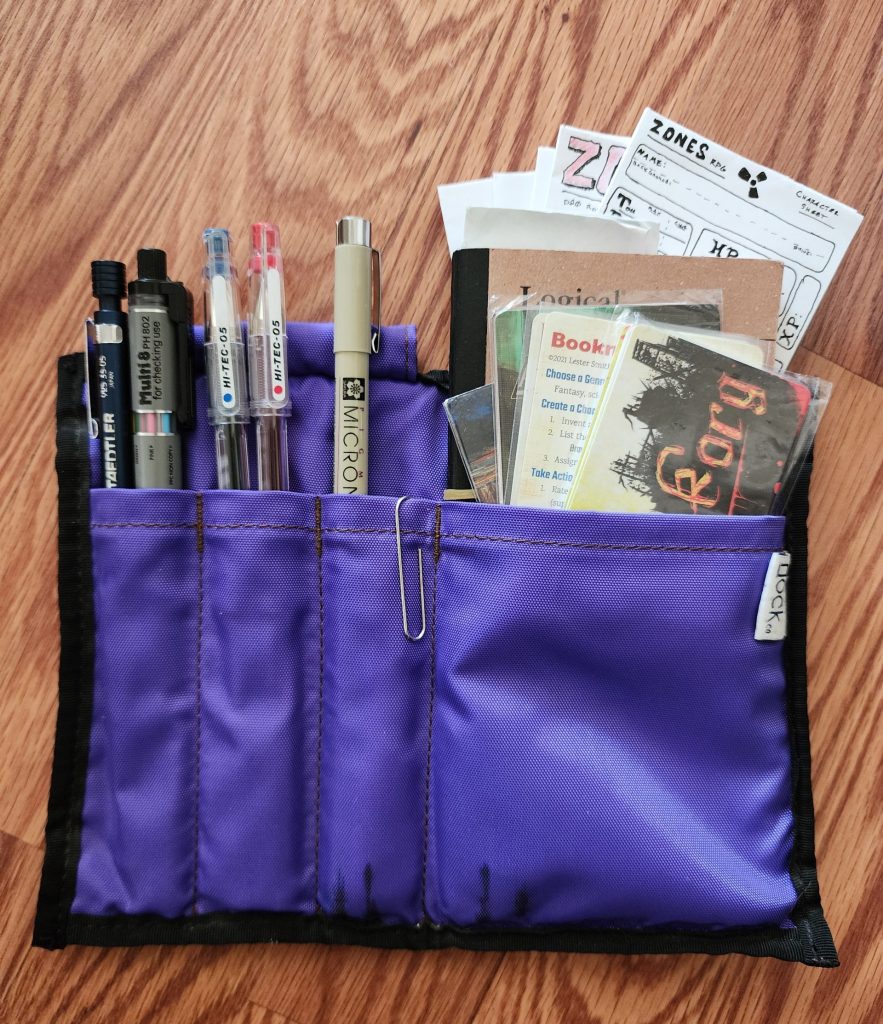
My kit is contained within a Nock Co Hightower case in Coffee and Amethyst. Sadly, this is a product no longer available (RIP Nock Co), and I only managed to get this one through sheer luck many years ago. It has a 3-slot pen case on the left, with a flap to cover them, and a single pocket on the right.
Three pen pockets, easily fits 6 narrow pens.
If you use narrower pens, as I mostly do, you can usually double-pack the pen pockets and fit up to 6 writing instruments, or similar size and shaped items.
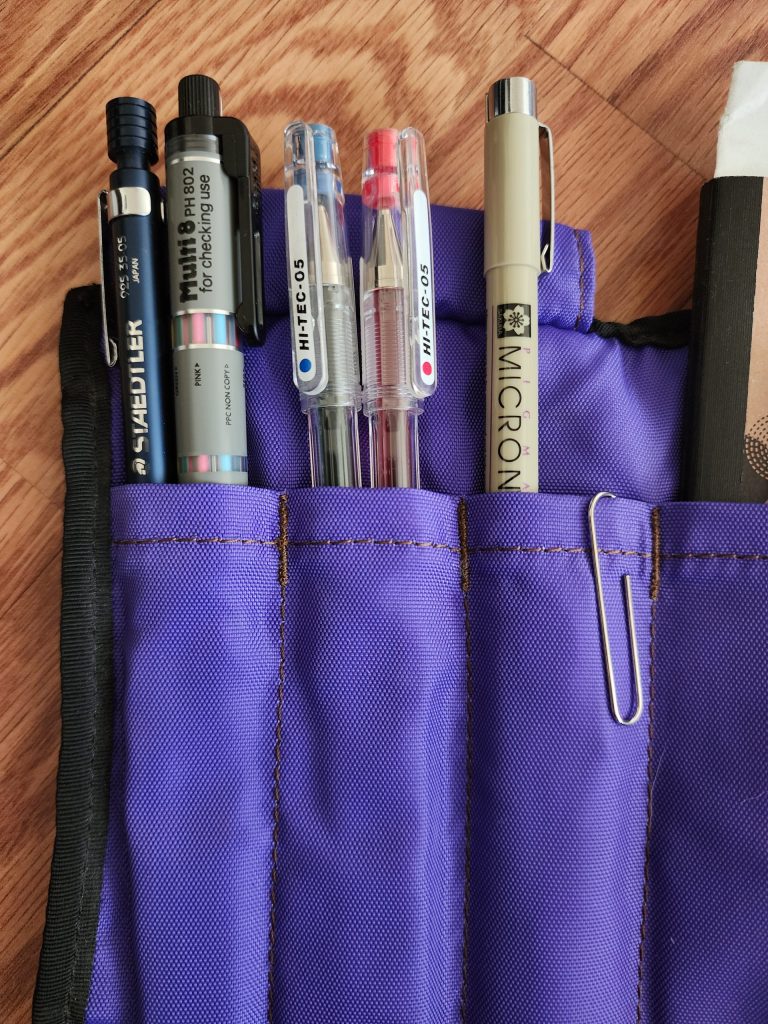
As it is today, I have the following items in the pen pockets:
Staedtler 925, 0.5mm mechanical pencil in midnight blue, currently filled with standard Staedtler Mars Carbon HB lead
There are other options for mechanical pencils, but I find this is the one that always ends up staying in my EDC. I do worry about bending/breaking the lead sleeve, though, as I am by no means gentle with this kit, and it often gets thrown about in my jacket, stepped on, or even dropped.
The Pentel Multi 8 is hit-and-miss. I find the leads aren’t the best fit for me, and they’re just a bit too easy to break inside the holder. That said, this is a great utilitarian piece, as it can hold up to 8 different colors of lead. If you color code your writing in your games, want to add some color to your sketches, or have kids who may suddenly want to draw, it does come in handy.
I find the 0.5mm Hi-Tec-C is better to carry around than the narrower 0.3mm or 0.4mm, as this is also the pen I will use to sign things, or even give to my kids if they would like to draw or play a game. The smaller tips take a little more care to write well, though they do let you take more notes in a smaller space.
I’m a big fan of the Sakura Pigma Micron fineliners. You can use narrower pens for fine details or space-saving writing, and the larger line widths can help block borders or delineate text space in notes.
The, currently vacant, 6th space is usually either filled with a fountain pen, such as the ensso Bolt, or another size Sakura Pigma Micron fineliner. Can never have too many fineliner sizes in your kit!
Mini-zines!Game and art cards.Index cards fit perfectly inside the B7 notebook as well.Ready to go hex map for on-the-go gaming.
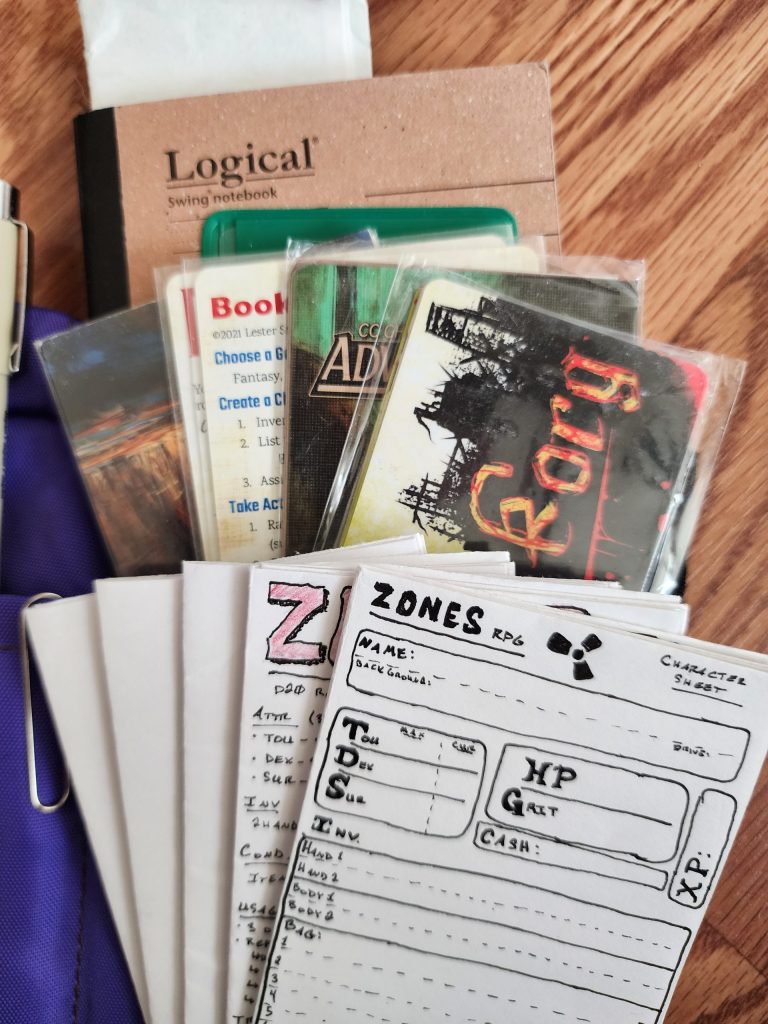
The deeper pocket on the Hightower can fit more than just a notebook. Here’s the current inventory I have tucked away:
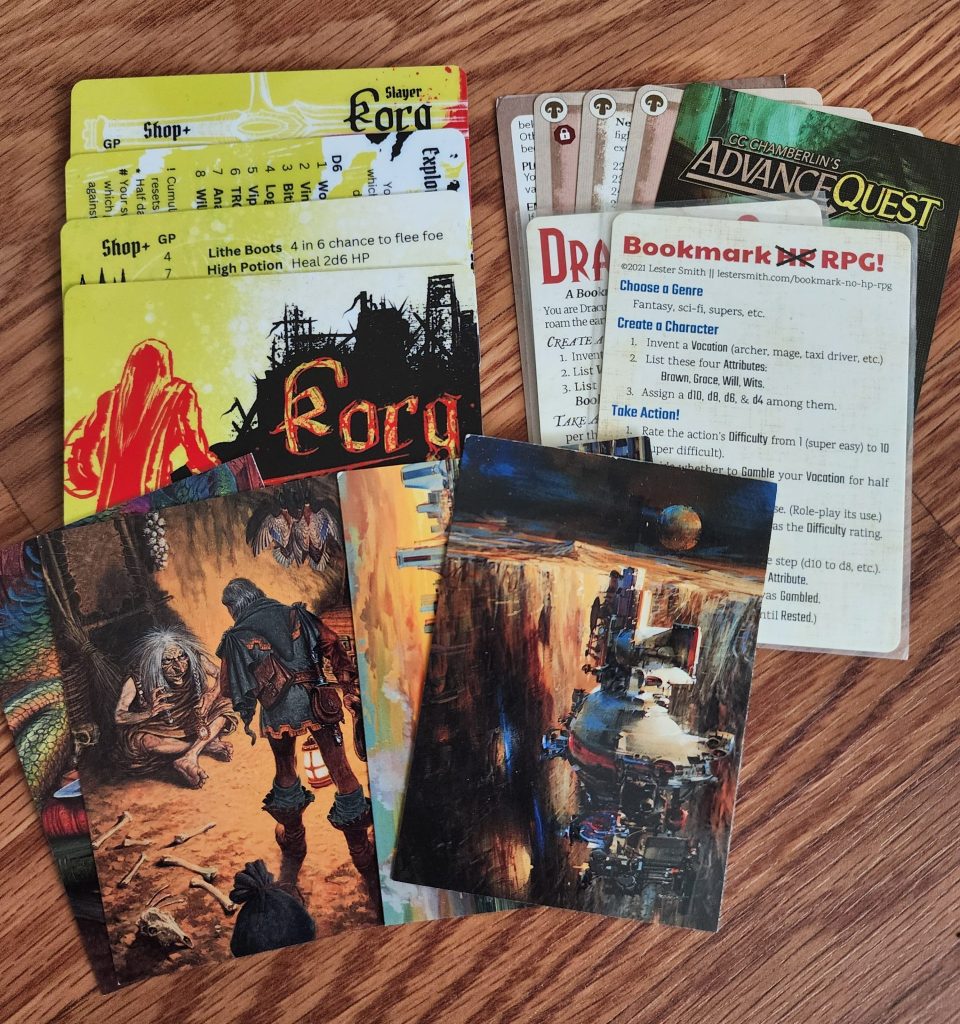
Bookmark No HP RPG, and Dracula’s Get, a small “sourcebookmark” for the same system. A quick, simple system to get you gaming fast by Lester Smith, that requires a d4, d6, d8 and d10
4-5 various art trading cards, for inspiration and mood setting
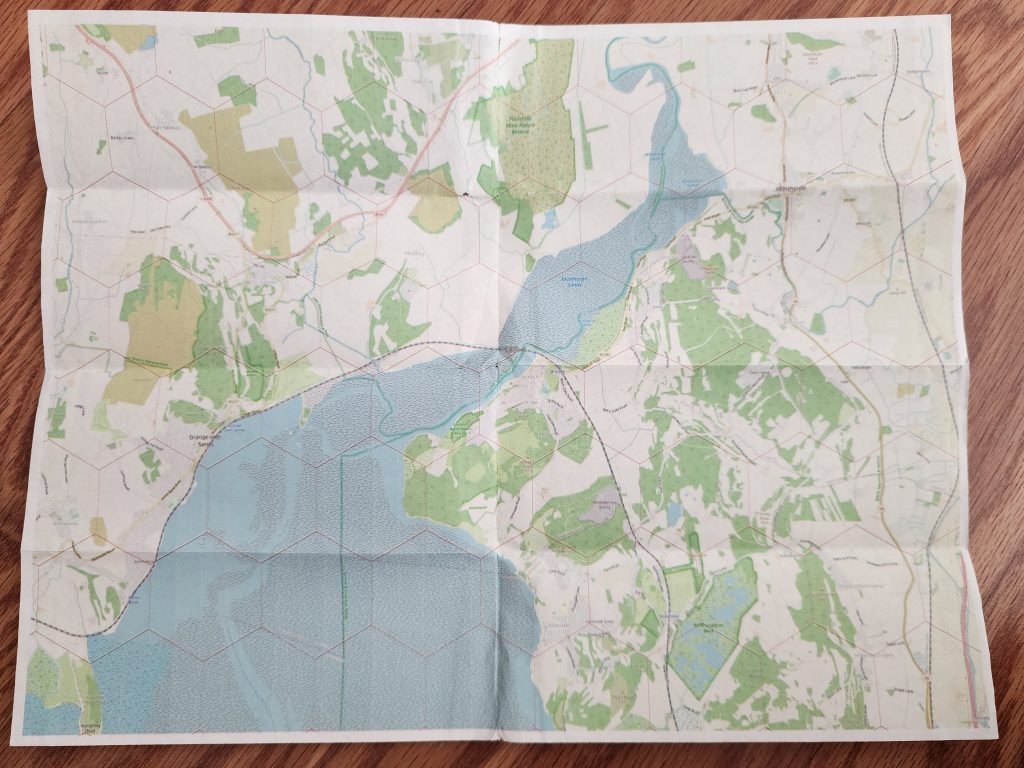
Random map printout with hex grid overlay
A small Fresnel lens, not necessary for gaming, but comes in handy if you need a little zoom to read, or write, small text
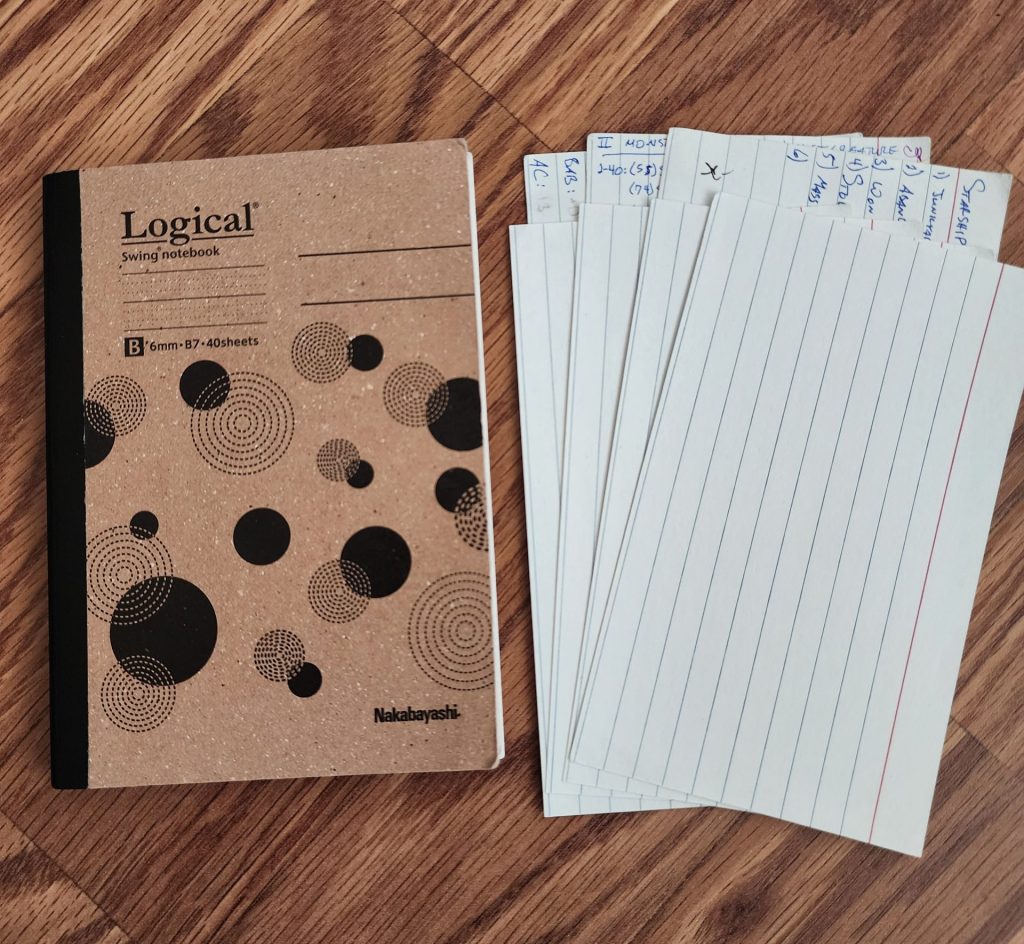
I have a local Daiso store where I spend way too much money on stationery items. That includes these Nakabayashi Logical Swing notebooks. I quite like the Nakabayashi lineup of notebooks, including their Logical Prime series. They’re not always the most fountain pen friendly, but most of my EDC kit is exempt from that anyway. I wish I could find more of these B7 size, because they haven’t been stocked in quite some time, but it’s not like I don’t have a stash of them… This notebook can track your stories, take notes on your games, jot down quick lists, whatever you need them for really.
Index cards are great for keeping as a character sheet, taking notes, or handing to your kids to draw on. If only the Nock Co DotDash cards were still around, they were some of the best index cards available!
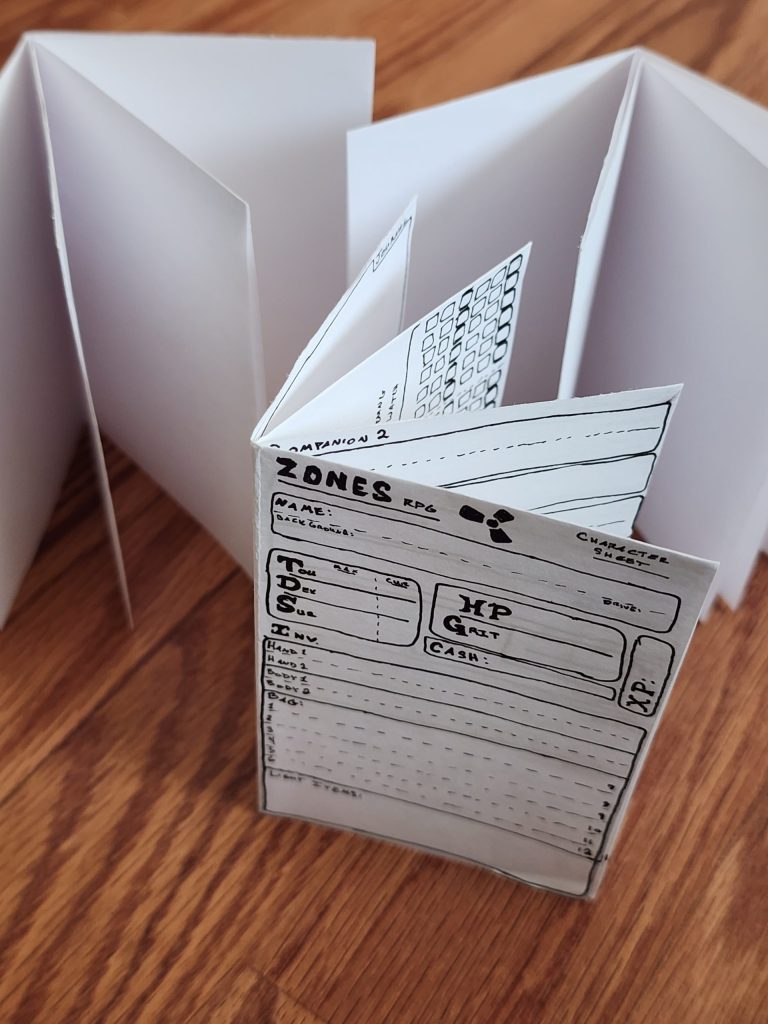
This probably deserves a post on its own, but I am obsessed with the 8-page mini-zine format. There’s a great page here (and I’ve seen several others out there as well), that explains how to fold a letter-size sheet of paper (with one simple cut) into this format. It’s perfect to keep in your pocket, you can keep notes on them, write down rules for your favorite RPG, create your own character sheets, and so much more! I almost always have one or two of these on me, and have had so many ideas for mini-zine content (I’ve never shared any though… maybe someday). In the image above, you can see one of these that I turned into a small character sheet for the Zones RPG, a system I’ve been trying to find time to play.
Korg, Advance Quest and Bookmark No HP RPG are all “pocket size” games that can be easily played while out and about, and require pretty minimal material to get going. You can keep notes on your game, or track your character(s), on a mini-zine or index card. There’s no wrong way to do it, and you only need to write things down if you want to. There are a lot of other, great, pocket games out there which could easily be switched out. Check out some of theseItch.IOpages dedicated to small, portable games. The Bookmark No HP RPG system has a bunch of additional material to cover different genre’s of games, and there are other AdvanceQuest games as well. Caleb, at Dungeon Havoc, has a bunch of other content for Korg, but I really like the original format which is easy to carry with me – I’ve given away several copies of this game to people, simply because it was easy for me to carry an extra Korg card with me.
I have cards from Darrell K Sweet and John Berkey in my EDC kit, but I have full (or nearly full) sets from a variety of other artists, including Borris Vallejo, Frank Frazetta, and Tim Hildebrandt. These are from the days when trading cards were really booming, and it wasn’t just for sports. Artist trading cards can give you inspiration for different settings, such as Borris and Berkey’s sci-fi scenes. If you want something to pull you out of the hustle and bustle of daily life, into a high fantasy or science fiction setting, find a couple cards that you really enjoy and carry them around. You can usually find them for under $1 apiece.
Quite some time ago I wanted a map to use for a game I was playing, and I ended up using Open Street Maps to pull up random locations till I found something I liked. Then I overlaid a simple hexagonal pattern to create a quick-and-dirty hex crawl map. I carry it with me all the time now, just in case I need a quick setting location.
But wait, you’re thinking how do you play those games without any dice!? They all require some form of polyhedral math rock, you even said so!
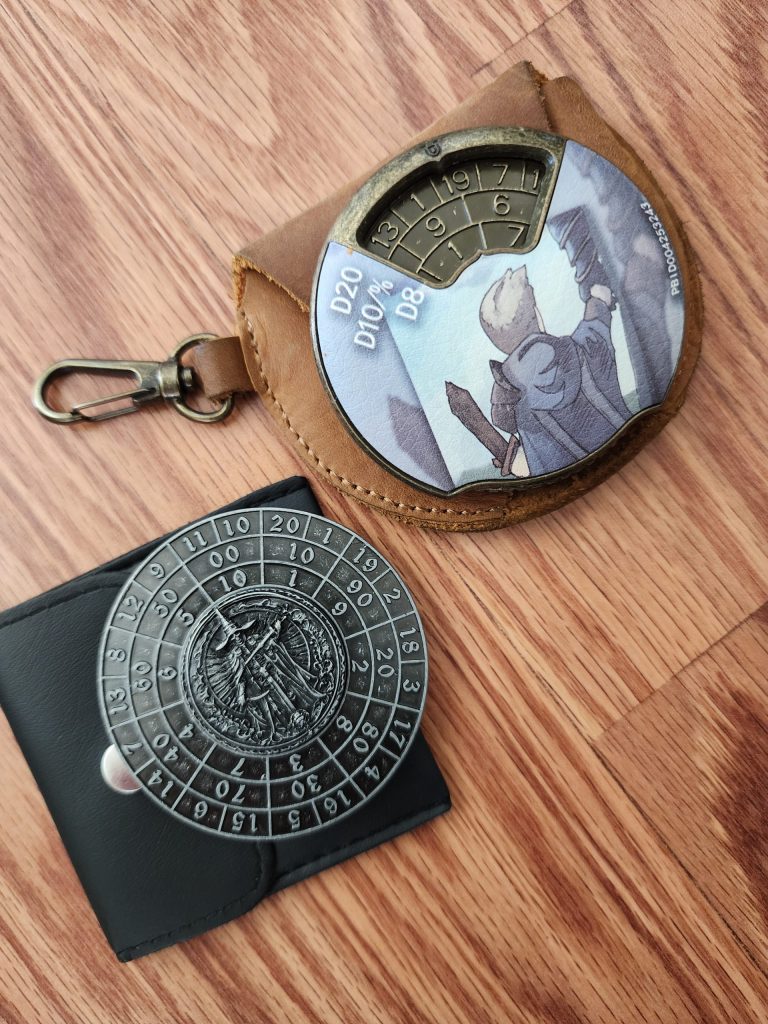
Dice spinners mean less worry about losing pockets full of dice.
Outside of my EDC case, I also usually have one of these on me. It’s a dice spinner, so you don’t have to carry a full bag of dice to play your favorite games (though don’t get me wrong, I’ve definitely done that too).
Each spinner has several concentric rings, and each corresponds to a different polyhedral die, from D4 up to D% (aka: rolling 2d10 or d100). You spin the “die” section, then use your finger as a brake to stop it. There’s an indicator to point where it “landed”, and that’s the number you “rolled”. Is it truly random? No, you could definitely work the system to get the numbers you wanted. But if what you want is to simply have fun? Then it doesn’t really matter anyway, you’re only cheating yourself!
A small, but mighty, case.
The Hightower case is deceptive in what it can hold. It seems like a simple 3-pen, 1-notebook case, but it can actually hold way more than that! It can wind up a little chonky, but mine usually lives in a jacket pocket where it doesn’t actually bother me. This is usually more prominent if I include other items, such as a Paper Apps game, which are also great little games to play on-the-go.
That’s the basics of my EDC kit, that’s usually with me whenever I’m out of the house. If I know I’m going somewhere where I might have more downtime, such as a day-trip, I’ll usually take something a bit bigger, that gives me more options and allows me to carry a full size book. Perhaps I’ll cover that in a future post!
Even if you don’t have your own EDC game kit, rather than pulling out a phone, just take a look around you. Take in the sights, sounds, and sensations of wherever you are. Maybe you’ll even find something that inspires a new storyline for your next Pen & Paper Quest.
I’ve been attending the SF Pen Show for 5 or 6 years. This was the first year I decided to focus more on classes than walking the show floor. I’d say that helped me spend less, but that wouldn’t really be true…
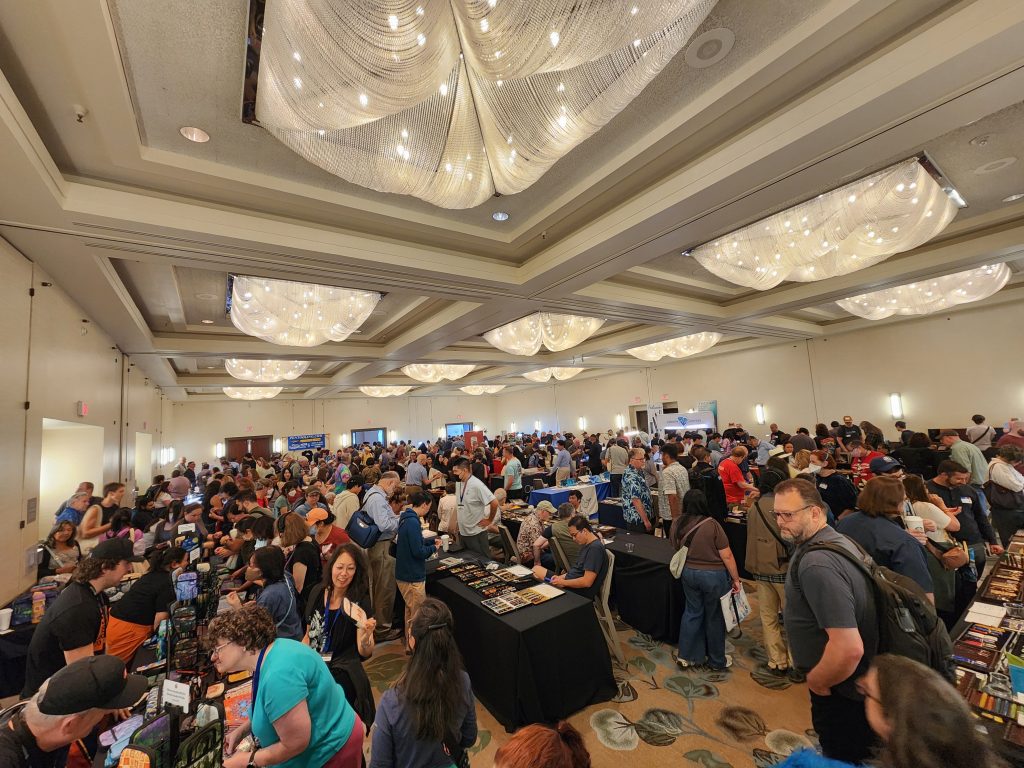
Now, the SF Pen Show normally runs Friday through Sunday. I don’t recall any classes and seminars on Thursday in the past, but they did it this year, and I’m glad I was able to attend Thursday through (most of) Saturday. It was a crowded show – more so than last year, which is a good thing, but I dare say it is outgrowing the space.
It was a crowded show!
I stayed at the hotel for 2 nights, which was a nice reprieve from my normal schedule and a much coveted break from my job. It was great just being around a bunch of pen and stationery nerds. Showing up on Thursday, I could see a lot of the vendors arriving and beginning their setup. There’s a lot of friendships between pen and stationery folk, and seeing them reconnect brought a smile to my face.
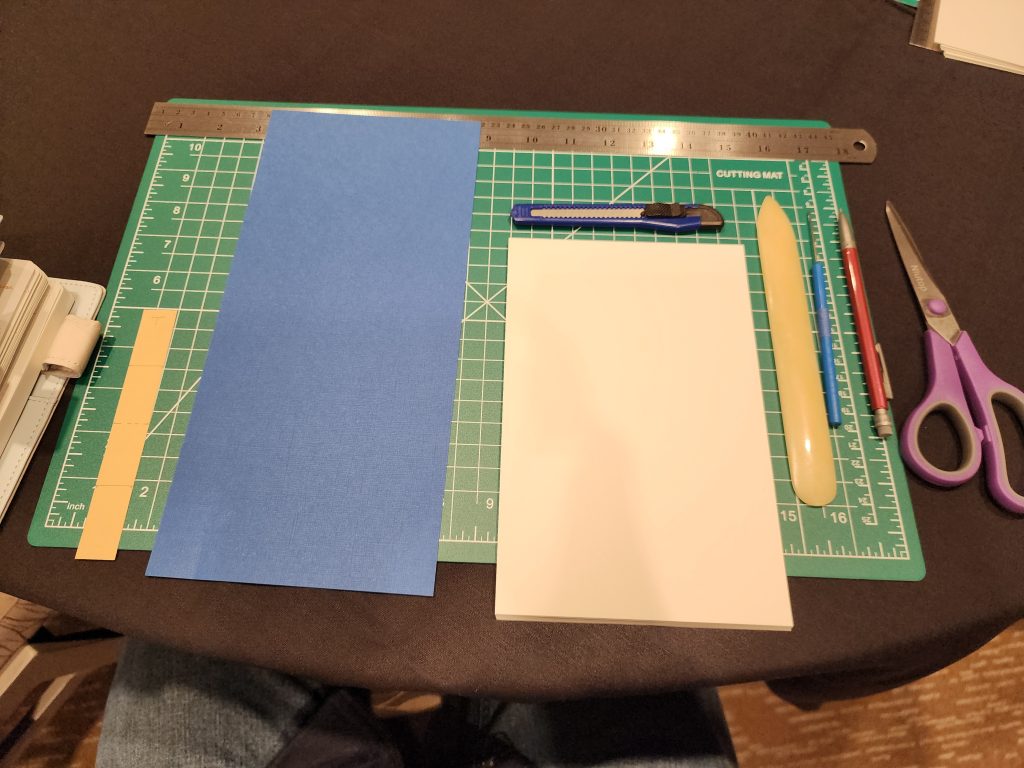
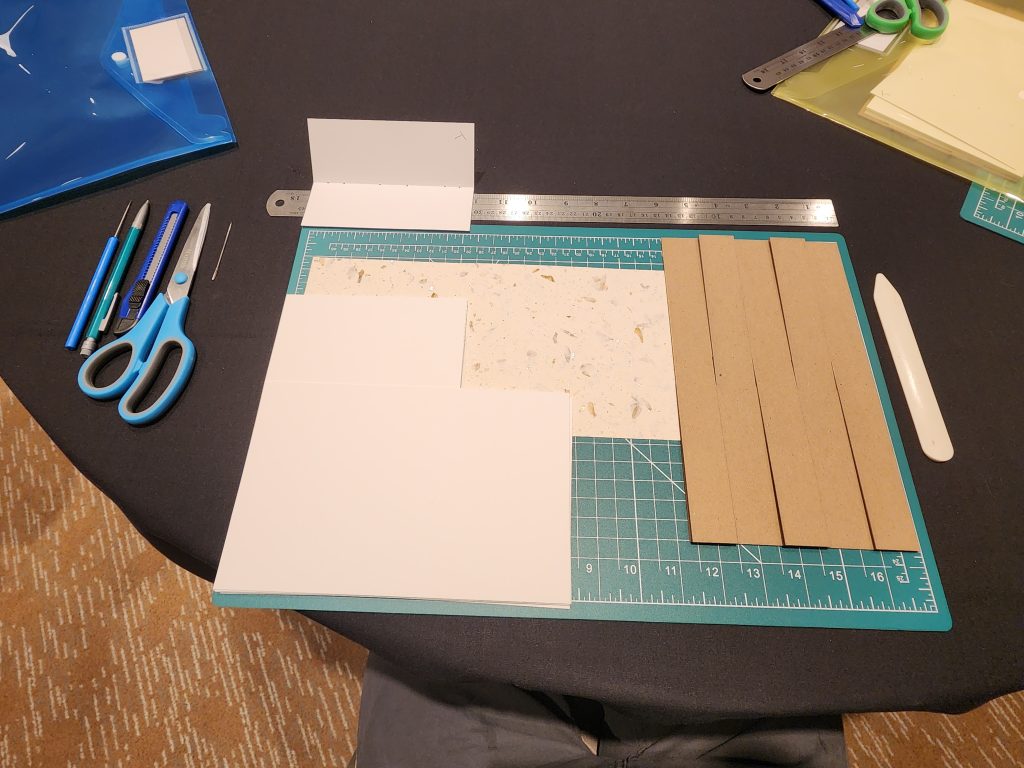
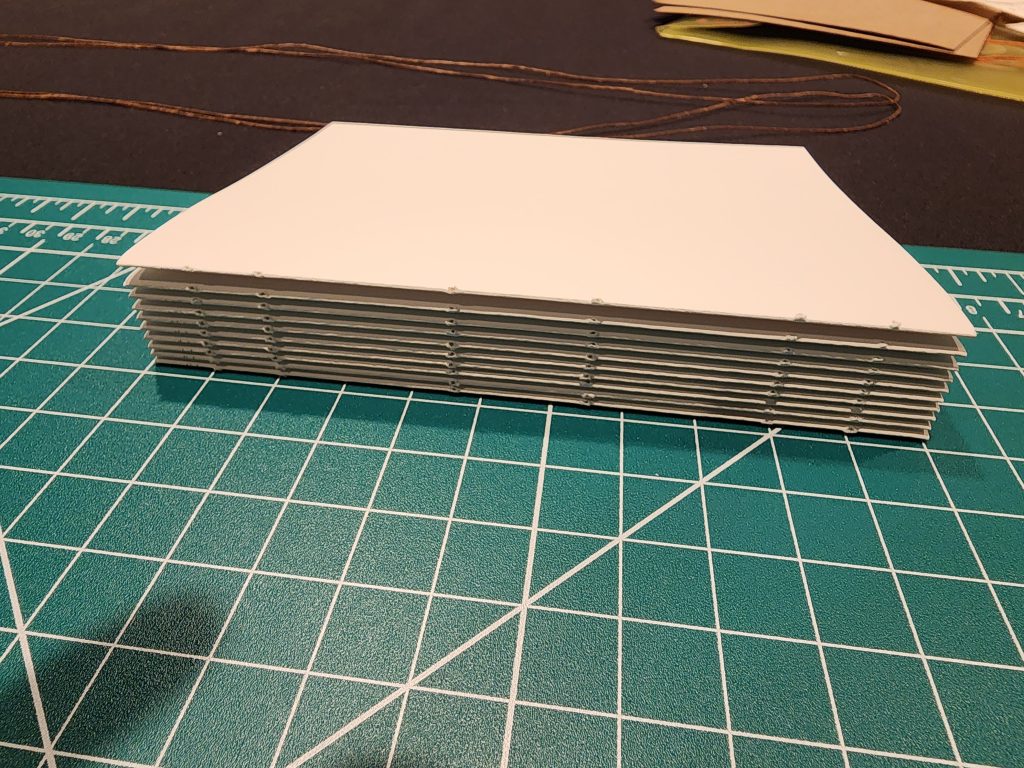
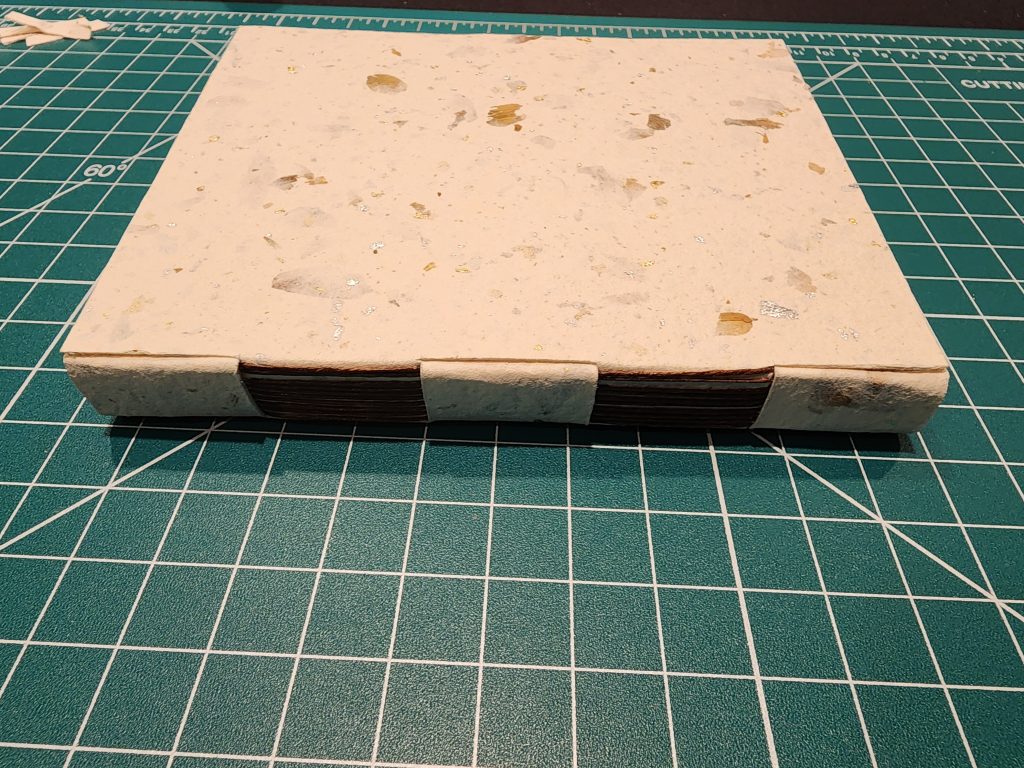
I can’t say I’ve ever attended past shows on a Thursday, and I don’t recall classes and seminars being scheduled that early, but they did this year. I attended the Buttonhole Stitch Binding class, led by Cheryl Ball of Rickshaw Bagworks (shoutout to her sister who was there to help during all of her classes as well!). This was my first time ever doing something like bookbinding, and it was a blast!
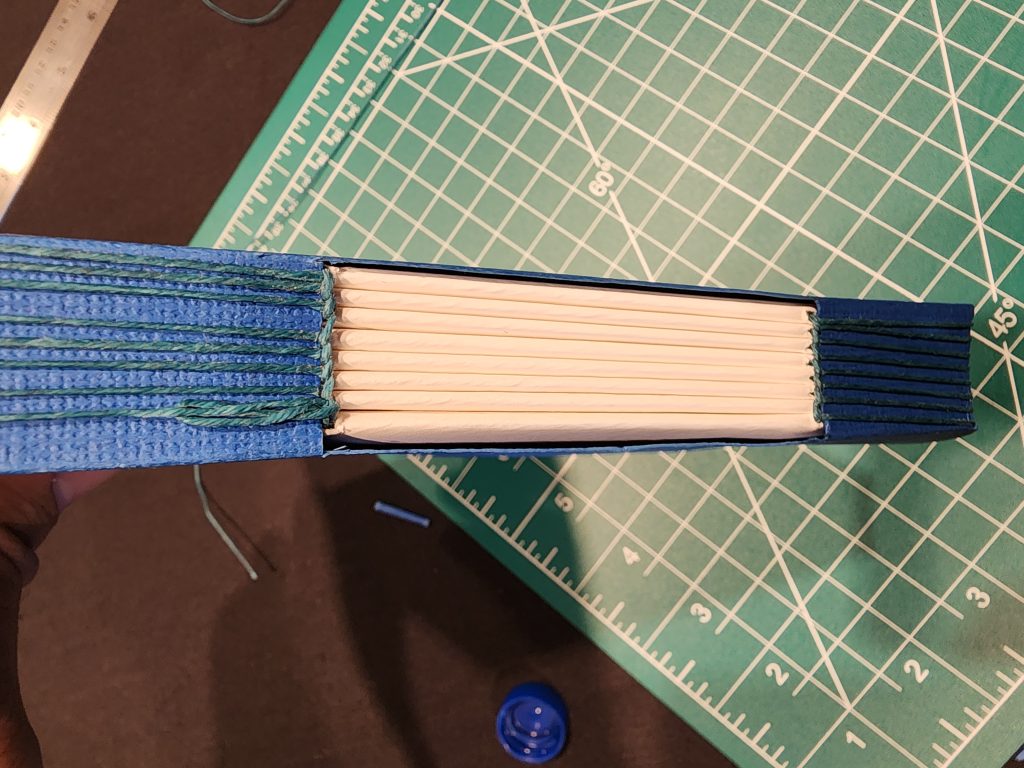
Cheryl is a great instructor, so I was able to quickly pick up the process, and once I got into the rhythm, it felt easy to keep going. It was a lot of fun learning the basics in a 2 hour class – the cover & punch template, cutting the cover, folding and punching your signatures (pages), and sewing everything together. I was nervous about the sewing -especially the part where you have to begin and end – but this binding in particular was actually really easy to start and didn’t require tying any tiny knots to finish either!
The final result was a roughly A6 size book, with a textured cardstock cover, and 8 sections comprised of 5 full-pages folded in half (80 pages, 160 front & back). We used Mohawk Superfine paper, that Cheryl had pre-cut to the size everyone would need. It’s smooth, with minimal bleed and some show-through; overall handling my fountain pen inks pretty well, with only the most minimal feathering from a wet ink+nib combo.
Seeing everyone focused on making this little book was fun, and I was able to help a couple people around my table when they got stuck. That’s one thing that’s great about these classes, usually everyone is very helpful!
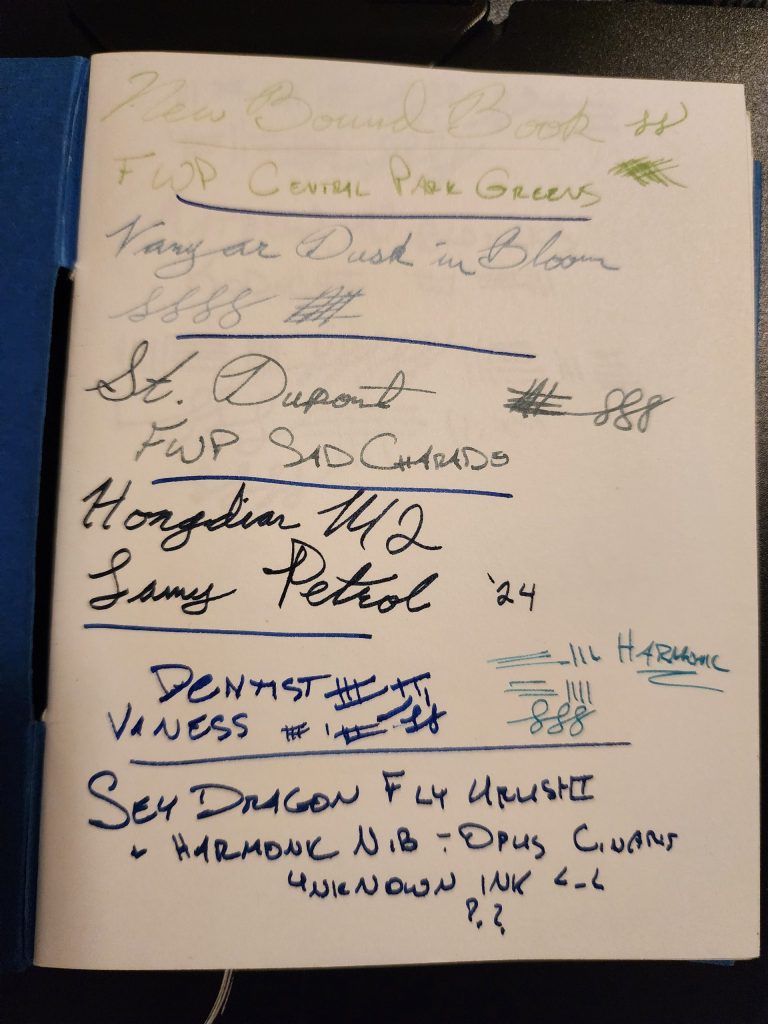
Various writing tests in my first ever hand-bound book!
For my Thursday afternoon I then attended two separate seminars. First was ‘Behind the Scenes with PLOTTER’ and then the ‘Panel Discussion with Vendors from Singapore and Japan’. The PLOTTER seminar was great to actually see their notebooks in person, and get a feel for them. They’re definitely not for everyone, but they look and feel like a quality product. Plus, they come in a ton of sizes and colours. Not to mention, getting to see a great video about the launch of PLOTTER TOKYO, the new flagship store! #TravelGoals
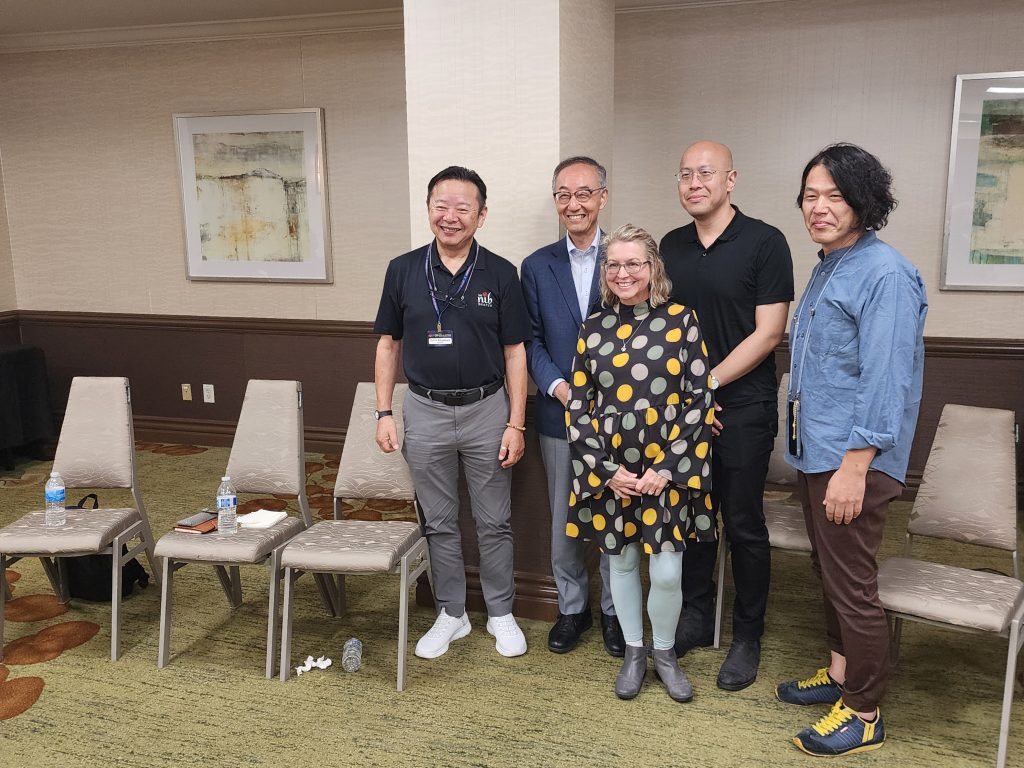
Lisa Vanness, of Vanness Pen Shop, led the panel discussion later that afternoon, and it was a really great to hear the insights and knowledge from such an esteemed range of panelists (thanks to the translators who were present to assist with this panel as well!).
Daryl Lim, of Musubi, shared his knowledge from the perspective of paper products.
Sajori Takahashi, of Sey, shared experiences as an artisan pen craftsman
Naoyuki Takeuchi, the head of ink planning at Nagasawa Stationery, provided insights in his vast experience in the world of inks
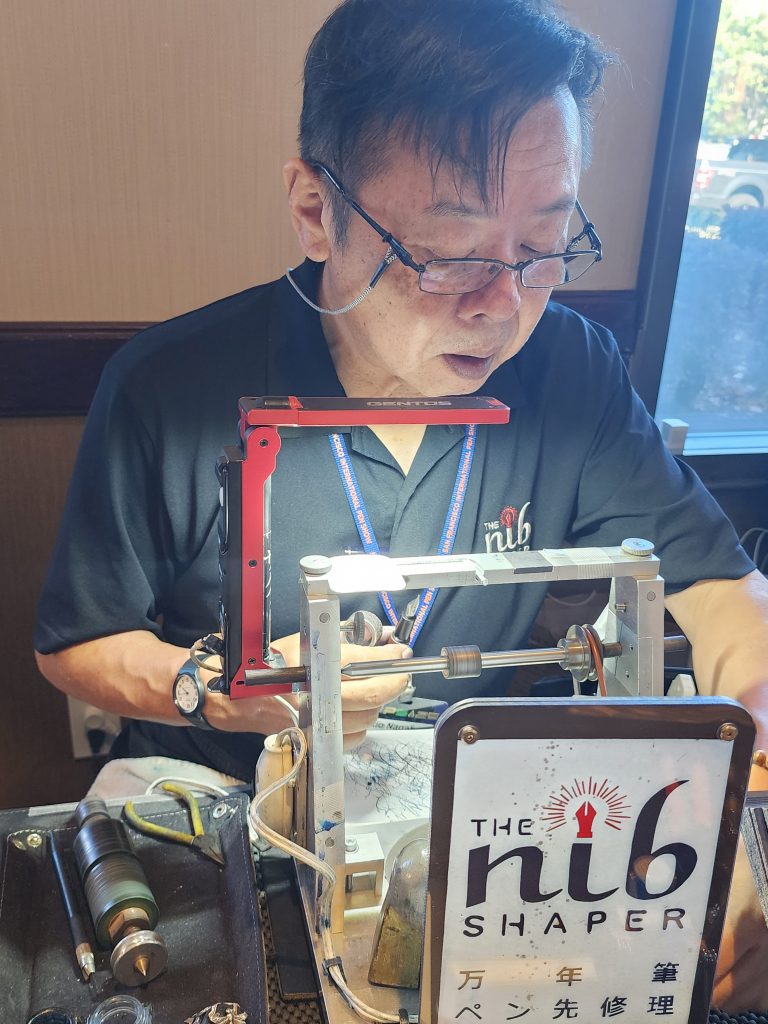
and Yukio Nagahara, a distinguished nib smith of The Nib Shaper, shared his perspective on nibs
Along with some insight into each panelists history in their respective fields, there were some topics of discussion around paper trends in different markets, the use of stationery in different countries, and more personalized preferences for pens, papers, and inks. It was a perfect blend of insight and laughs; a highly enjoyable experience, and I’m looking forward to seeing what they do next year.
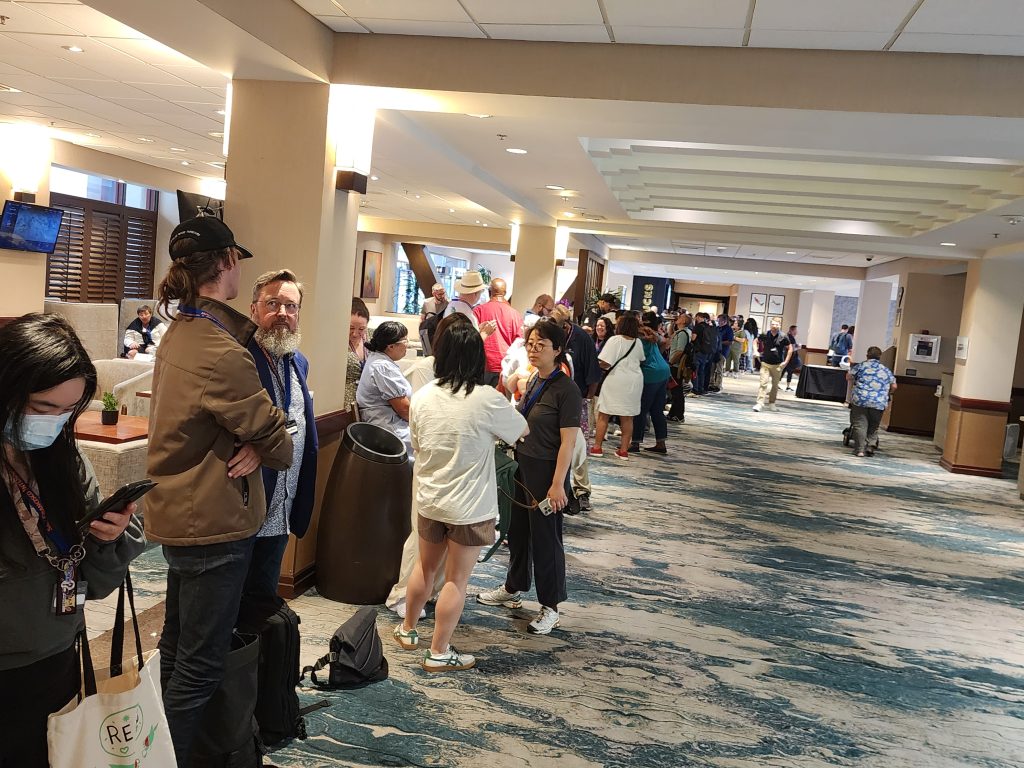
The all access pass lets you get in early on Friday, and since I had nothing to do, I showed up to the lobby 2 hours early. There was already a line forming. One hour before early entry opened, and the line was down the hall and out the hotel doors.
The crowds waiting to get in.
After finally letting everyone in, I had all of 5 minutes to wander the floor before I needed to find where my first class of the day was located. Pro-tip: If you are going to the show looking for something specific, which may sell out, definitely do not schedule classes during the opening hours!
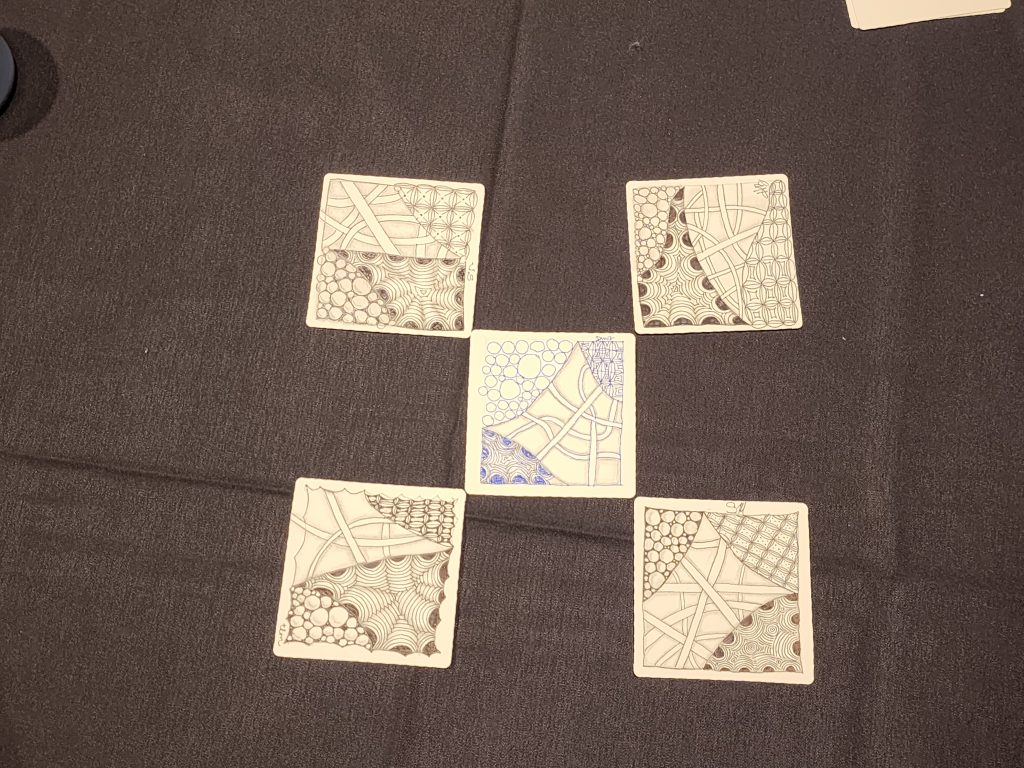
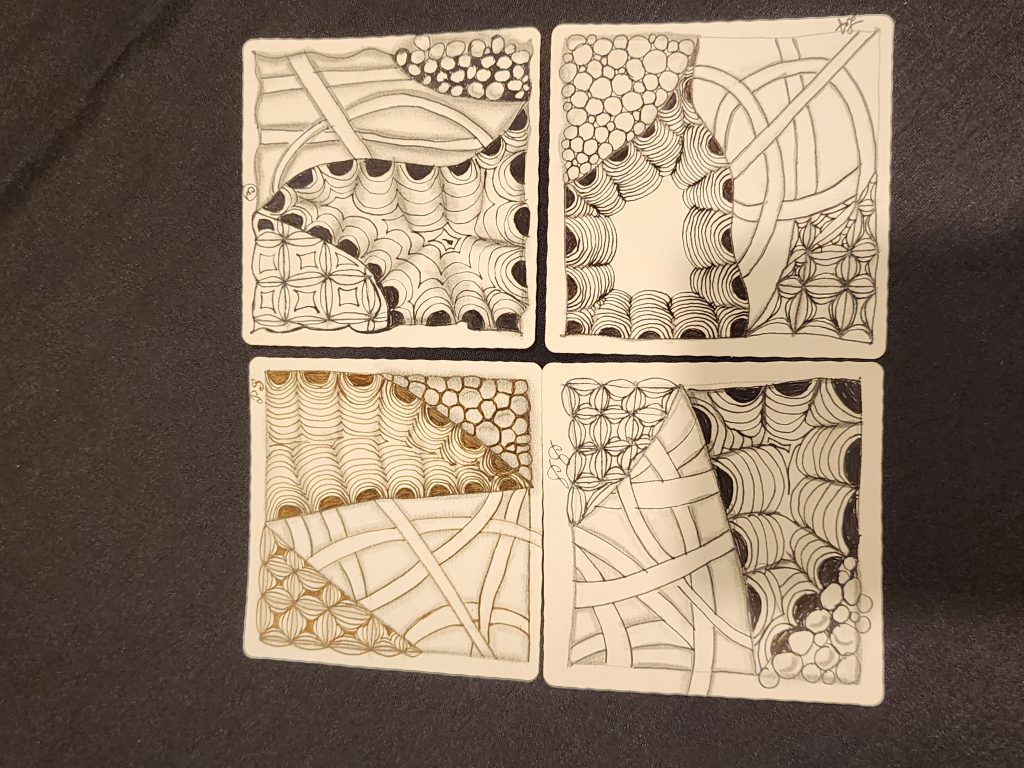
First class of Friday was Mindful Zentangling with Analisa Bevan. I had never heard of Zentangling before, and mostly took this class out of curiosity. I’m glad I did, as it turned out to be a great creative outlet! In my own words, Zentangling is a mindful period of relaxing, pattern sketches.
Analisa is a Certified Zentangling Teacher, and started class by letting everyone know that there’s no wrong way to practice Zentangling! There’s an 8-step process, to relax, go through the sketching, and then appreciate what you’ve created at the end, but you don’t have to follow the steps outright. After the guided practices, everyone laid their artwork out on the tables — they all turned out great, and some were done in very colourful (fountain pen) inks.
Once everyone finished going through the 4 patterns that were practiced, Analisa also shared some of her personal journals where she collects different Zentangling patterns. I didn’t get any pictures of them, but they were absolutely amazing! Lots of deep patterns, great shading techniques, and beautiful artwork.
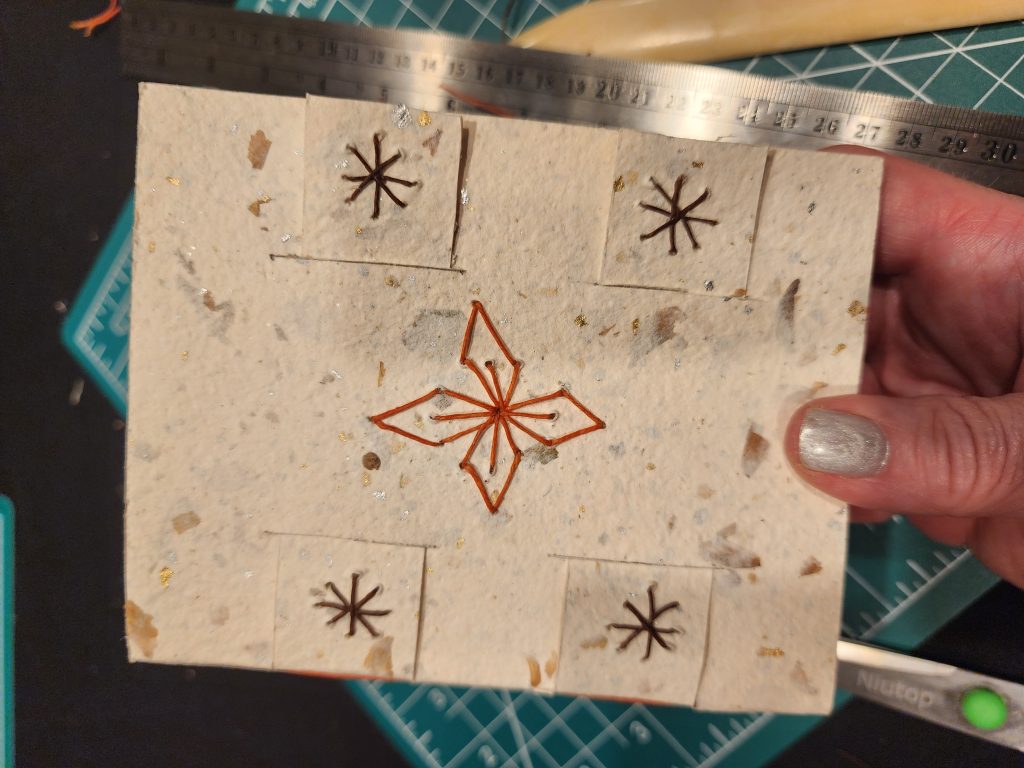
Shortly after Zentangling class, I went to my second bookbinding class with Cheryl Ball. This one was the Cross Structure Binding, and right off the bat it looked more intimidating than the buttonhole stitch binding because the cover layout was more complex. It was just as fun as the first class! In fact, the cover offered more opportunity for artistic expression, as I witnessed in class, when someone embroidered a flower and accents on theirs!
Some very talented folks joined this 2hr class, and came out with some fantastic looking books in the end. I was very happy with how both of my books looked, and I’m looking forward to practicing some of these skills again. I may even try adding some additional details to my cross structure bound book.
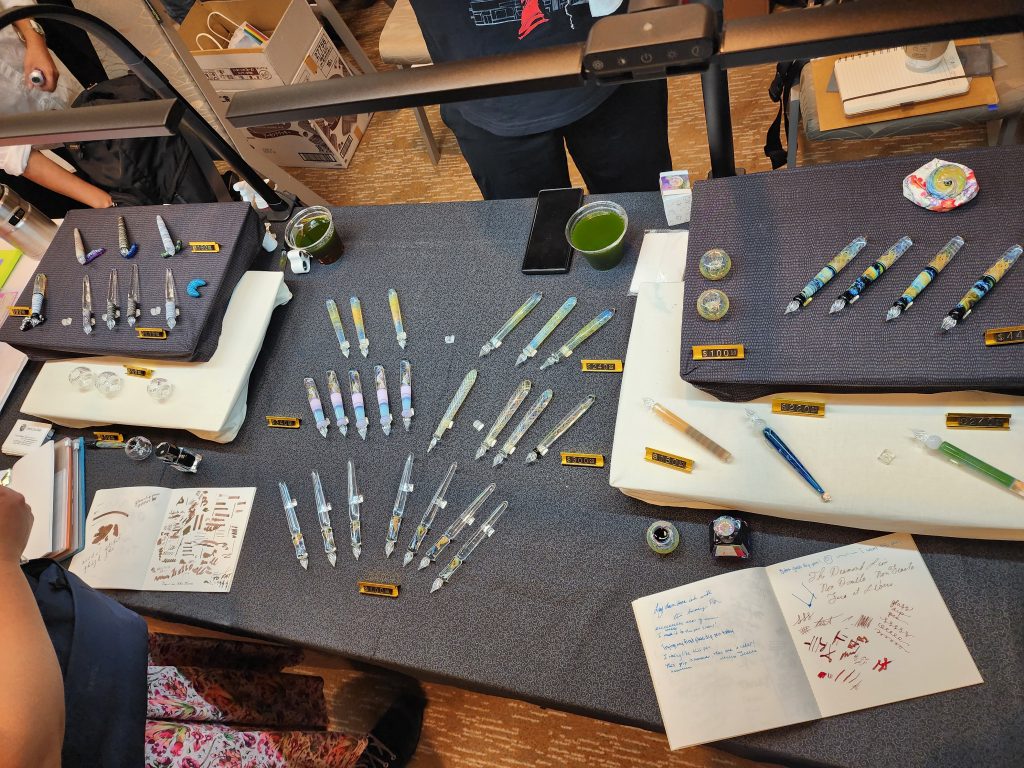
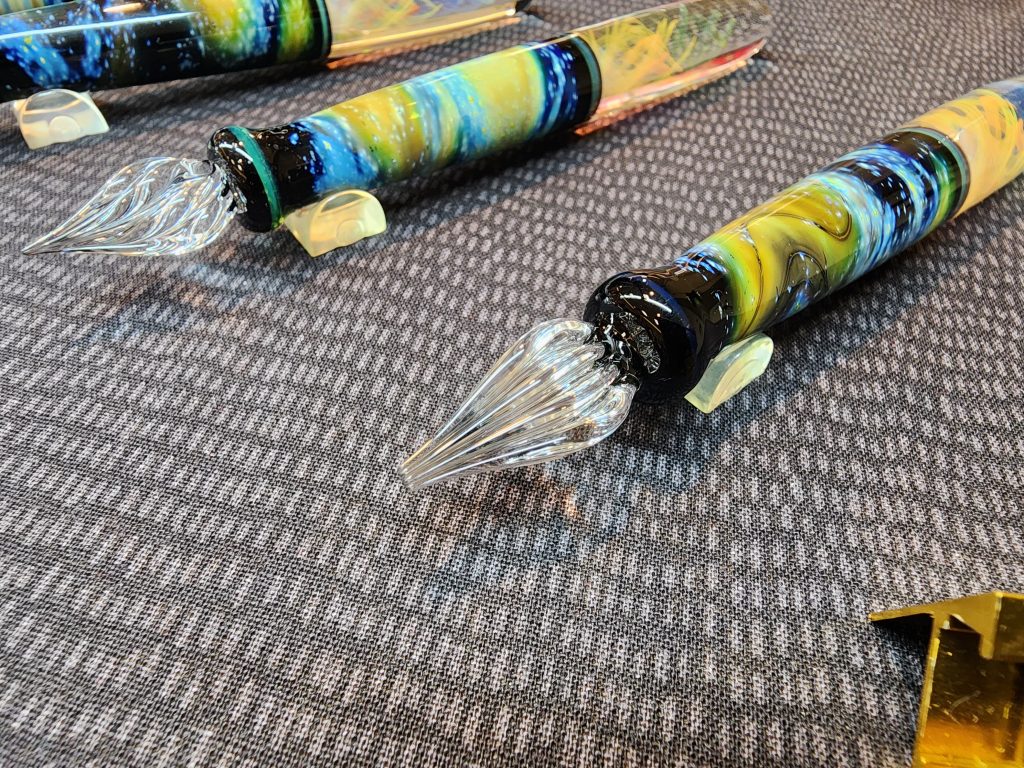
I had planned to attend some other events on Friday, but ended up spending most of the day wandering the show floor, checking out a lot of the products and chatting with different vendors. I’m terrible at remembering to take pictures, so don’t have many to share. I do have the two below, that I took while chatting with Lucas Mahoney of Hanabi Glass Studio about his glass dip pens. A lot of time and talent go into making each of these pens, and they wrote very smoothly. Lucas explained some of the process he goes through to make a pen, including the nib to ensure it writes smoothly and continuously, and changing colours in the more complex pens. I didn’t pick one up this time around, but these are definitely on my “look into getting one of these” list.
The last thing I did during the Friday show hours was to get a couple of nib grinds. I never know when most nib grinders put up their sign-up sheets, so I never end up getting an appointment slot. This year was no different – so I took a chance to see if I could get in with the nib grinders who do first-come-first-serve walk-ups!
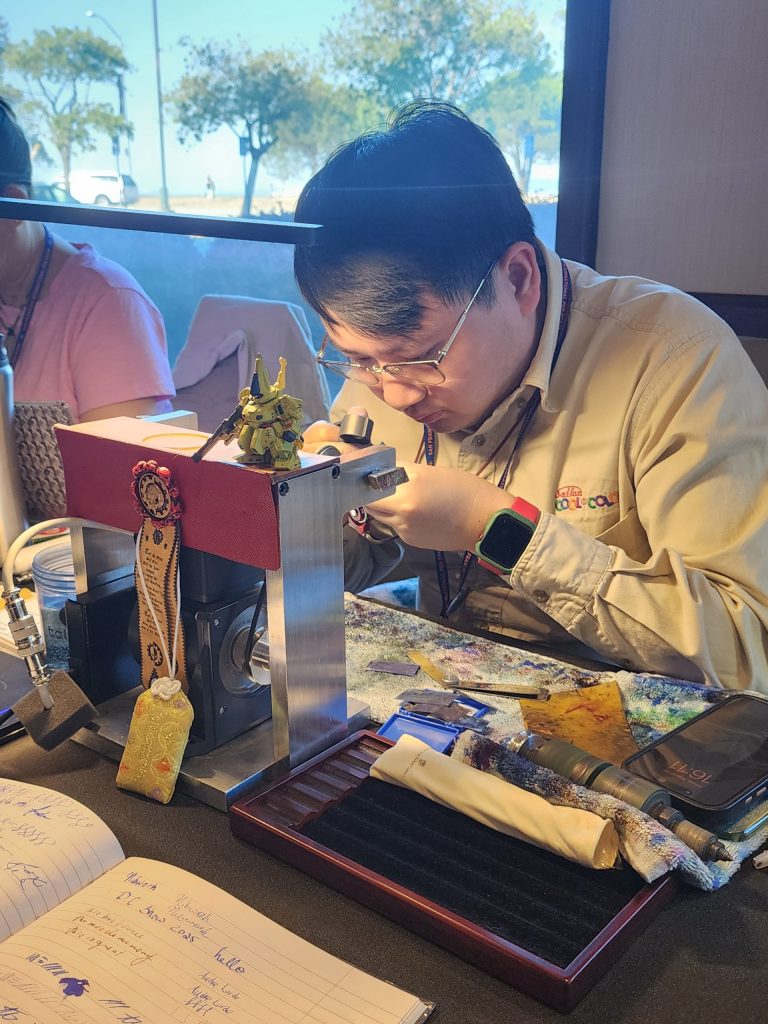
One of the grinds I got was from Matthew Chen, of Matthew’s Nibworks, and the other was from Yukio Nagahara, of The Nib Shaper. I managed to snag the last time slot of the day with Takuma Nagahara, Yukio’s son, who also does grinds, but after Yukio’s last appointment was a no-show, they asked if I’d like to sit with him for my appointment and I gladly accepted! It actually worked out better than I expected as my appointment times ended up coinciding, but since they were setup next to each other, I was able to work with both of them at once (I do not recommend this to anyone, it’s probably a great way to lose a grind appointment!).
I’m barely daring enough to use a brass shim on my nibs, so I have a lot of respect for anyone who takes a pen from other people and is confident that they can create a perfectly tuned writing experience. I consider myself very easy to work with, however, and I was really pleased with how both grinds turned out.
My final event, on a very eventful Friday, was to attend a Techo Kaigi put together by Luca Barranco. It was a nice way to end the day, sitting around and chatting with others about how we use our journals and notebooks, what we would like to do better, and sharing experiences with different products. After it ended, I headed back to my room and crashed.
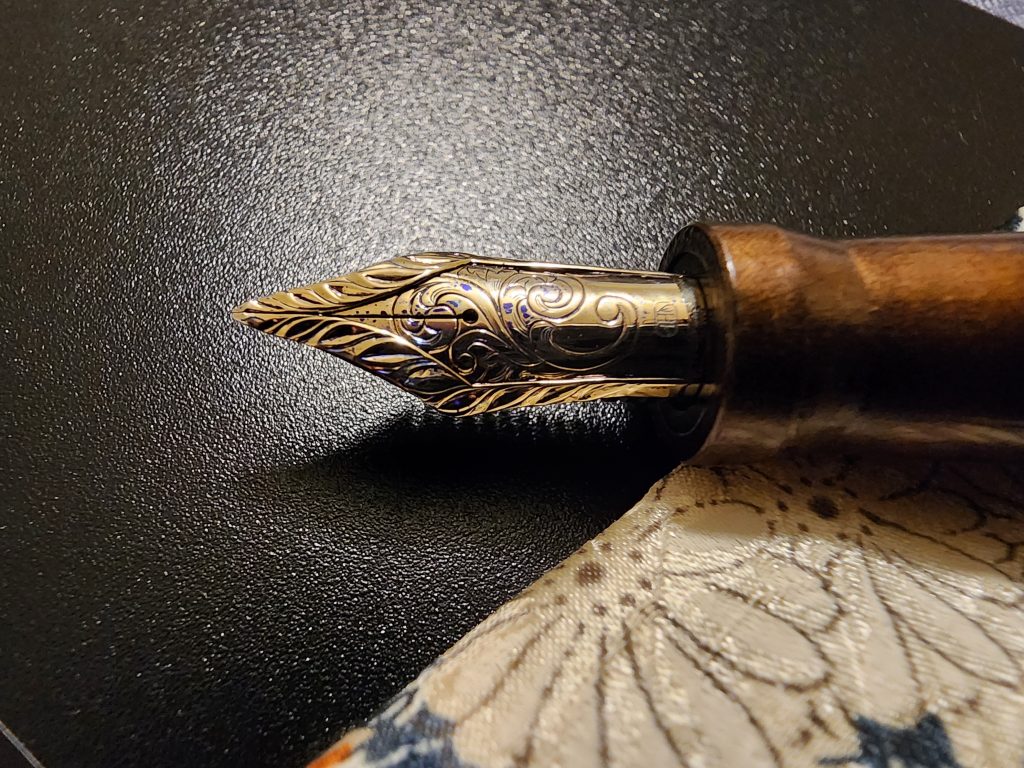
Saturday was my last day at the show, and I really only had one item on my agenda for the day. Some months ago I had put my name on a wait list with Opus Cineris, not thinking I would ever actually get an opportunity to acquire a Harmonic Nib. Guess how surprised I was when Anabelle Hiller sent me an e-mail several weeks before the SF Pen Show! I had a 9:30 AM pickup time for my nib, and it was one of the most delightful experiences I’ve ever had at the SF Pen Show. Anabelle does amazing work, and from a handful of pictures of me holding a pen to paper, was able to put an architect grind on my nib that worked perfectly.
The beautiful nib aside, the experience of sitting down and chatting with Anabelle was an absolute delight. Between giving me a brief intro to music theory and discussions of my entry into the hobby of fountain pens, we decided that between us we made up at least half of Brad Dowdy’s personality by introducing him to F1 racing and journaling/solo RPG’s respectively. Thirty minutes passed too quickly.
My terrible photo does not do this nib justice
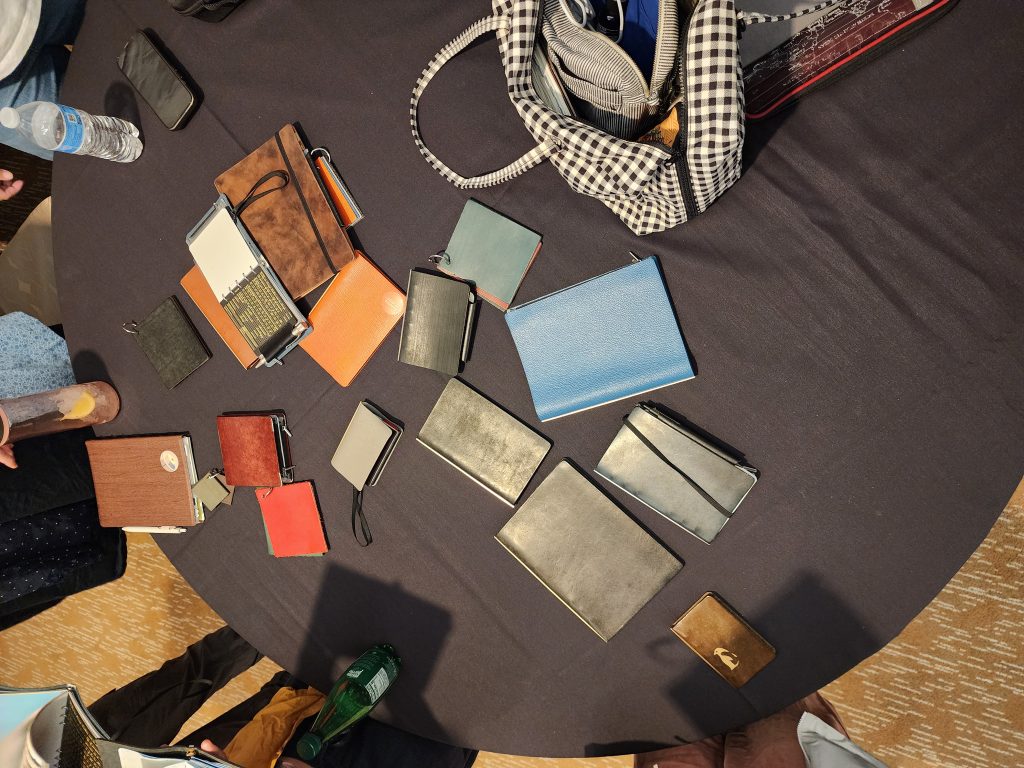
While I thought my time at the show would end there, I actually visited a few more vendors, and then sat in at the San Francisco Stationery Meetup. Another relaxing time off of the crowded show floor, with a lot of de-stashing, discussions and ink testing. I used the time to review all of my acquisitions (perhaps a post for another day), and confirm I had indeed spent far over budget. When the meetup concluded, I ended up seeing none-other than Cheryl Ball come in to prepare for her next class!
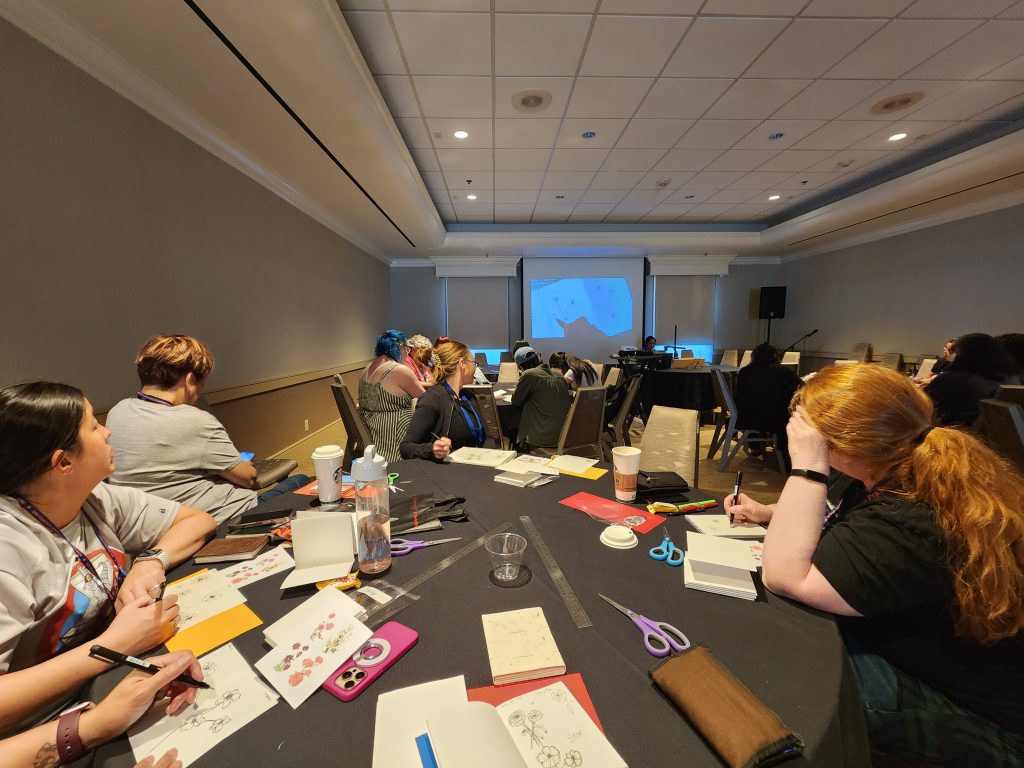
After discussions and sharing pen show hauls, I found myself volunteering to help Cheryl and Carola with their collaborative class on Creating a Floral Sketchbook. Since I had helped some people during the other bookbinding classes, I felt comfortable going into it and was glad I could assist everyone coming in, and help make sure no one fell far behind.
Cheryl and Carola knocked it out of the park! With Cheryl teaching how to create a small accordion style sketchbook, and then Carola teaching how to sketch several varieties of flower to fill it with!
First half of their sketchbooks done, Carola then taught how to sketch several different types of flowers.
At this point, I had already spent more time at the pen show than I originally intended to – not that I really minded – and decided I really should head back home. So, after one final chat with Daryl, at Musubi (whom I had a couple small discussions with during the show, and who sold out of nearly all their stock by mid-Saturday!), my time at the 2025 SF Pen Show ended.
It was a great show, and honestly, I surprised myself with just how social I was, considering how usually I am not. It was definitely a drain on the social battery, but well worth it.
This was not the planned “first post” on this blog, but hey, if I’m finally getting out of my own way to post something, so be it!