Category: TTRPGs

Tabletop Role-Playing Games – Mostly played solo

  • Free RPG Day 2026

    This past weekend was one of the few events that I look forward to all year. On Saturday, June 27th, Free RPG Day took place at Local Gaming Stores (LGS’s) across the world (except for some locales who had delays in shipments, sorry ya’ll!).

    Free RPG Day (FRPGD) is a great reason to visit local game shops and support small businesses (as most LGS’s are). Game publishers of all sizes partner with the organization behind FRPGD to send ruleset quick starts, adventures, game samples, and all sorts of goodies to stores. The goal? Get more people into their LGS, foster a community of like-minded individuals who love tabletop gaming, and get some more games out there for people to try!

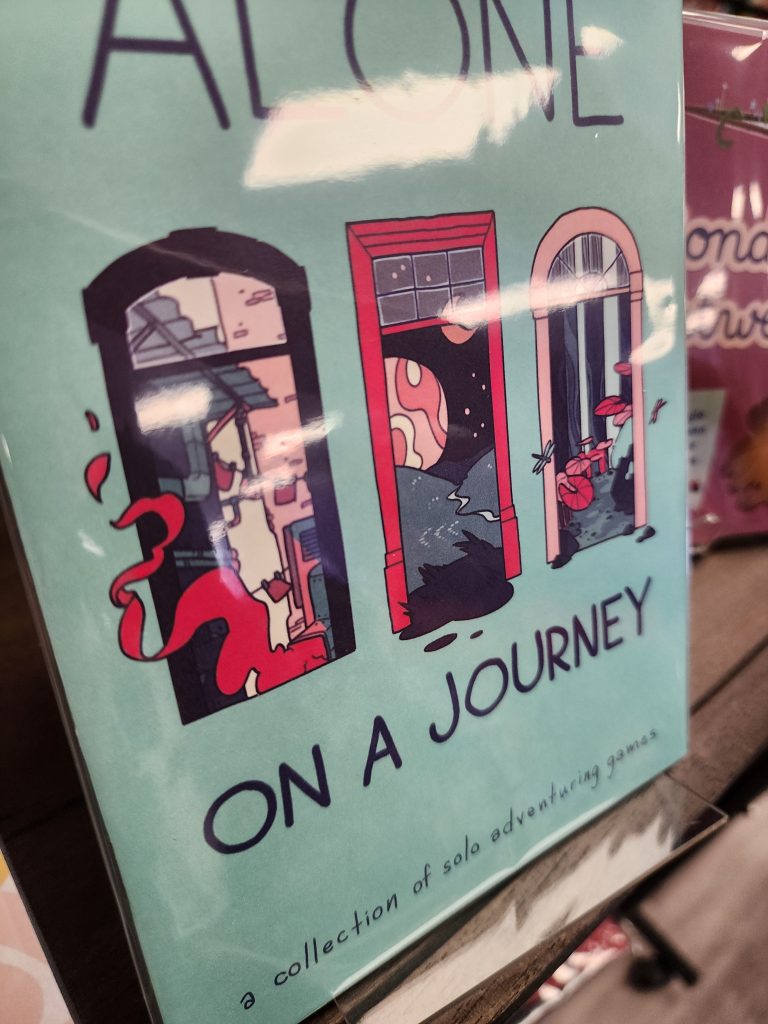
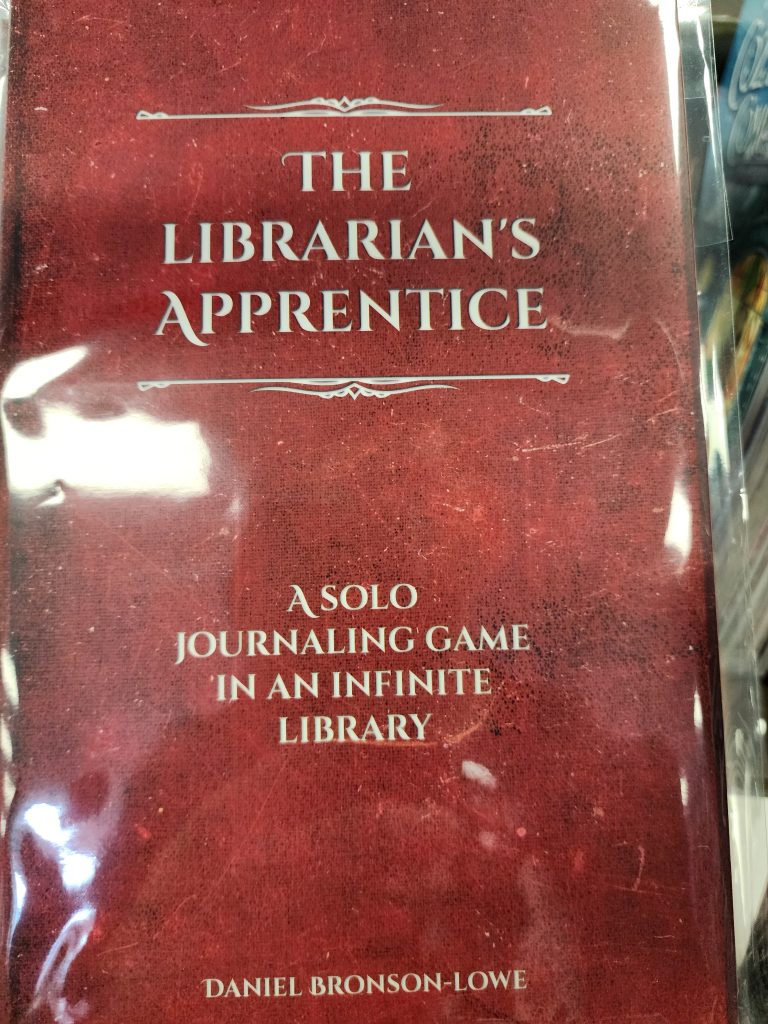
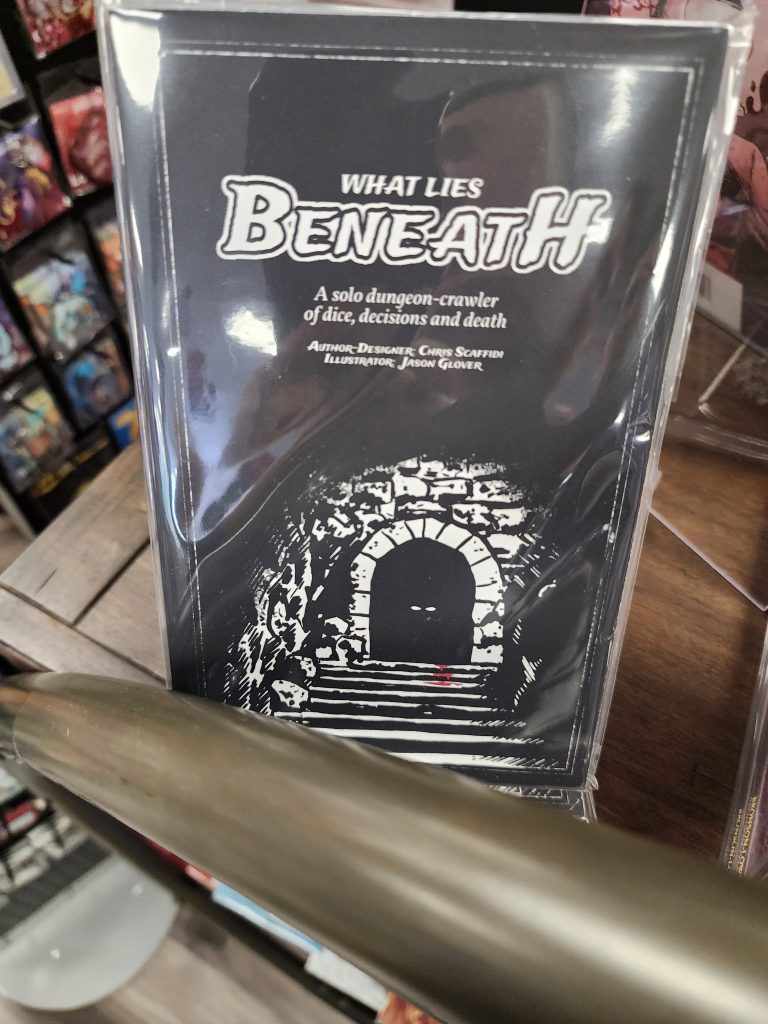
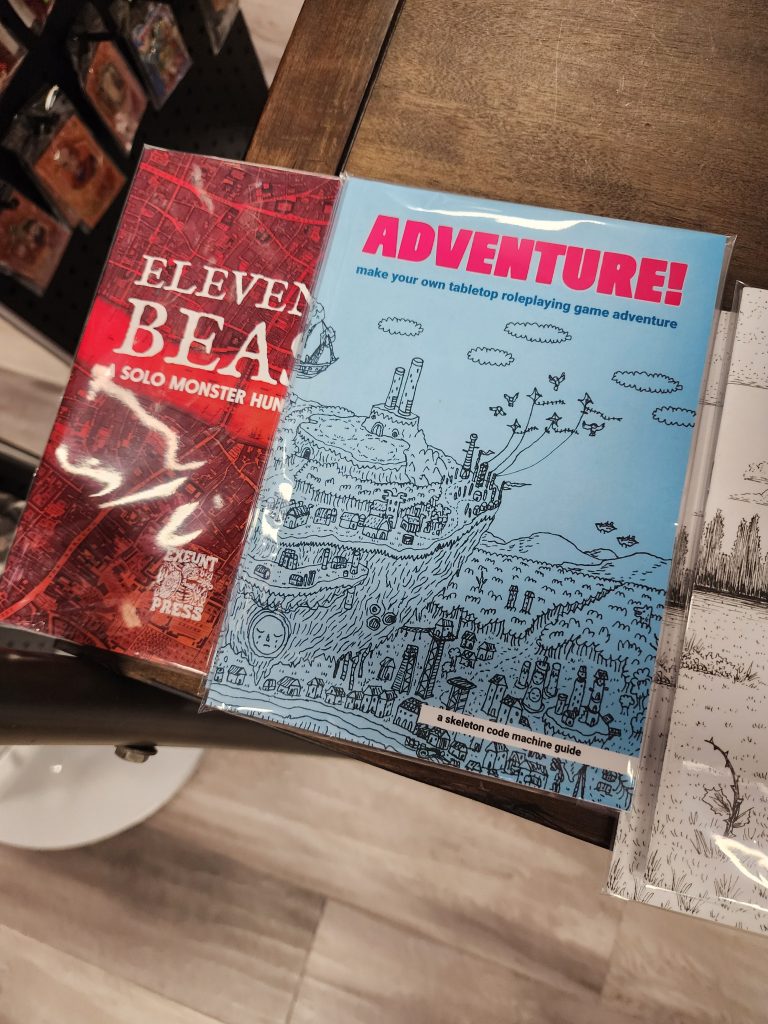
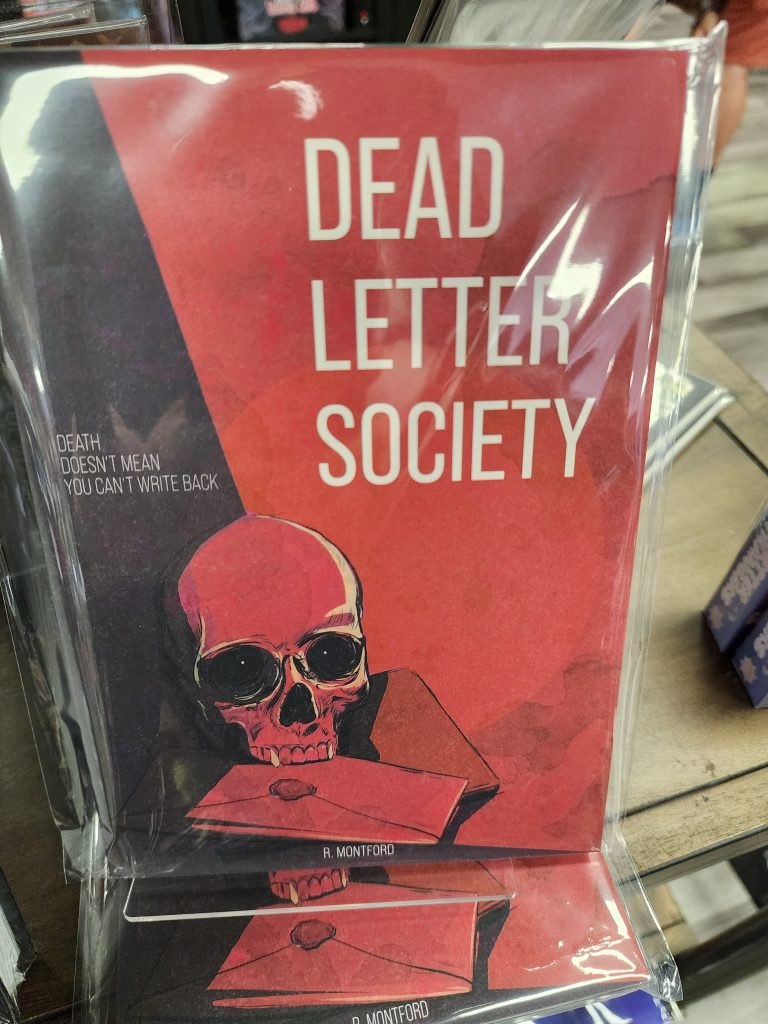
    This was exactly the kick I needed to visit an LGS that I haven’t been to in quite some time, since it’s now a 40+ minute drive away. I’m glad I made it out, because I had a great time browsing the large offering of board games, TTRPG’s, dice, comics, miniatures and more. I got to read through some of the, new-to-me, Dungeons & Kittens RPG core rulebook, check out physical copies of Dead Letter Society, Librarians Apprentice, Eleventh Beast, and more. Honestly, they had a much larger selection of solo-focused RPG’s than I would have thought!
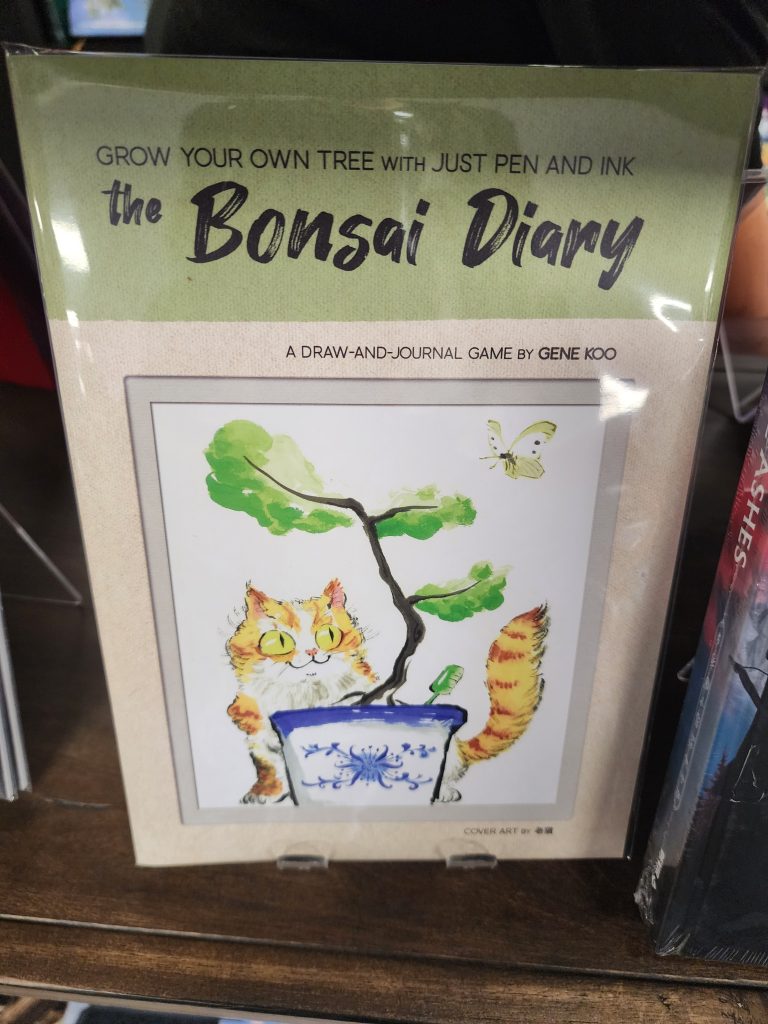
    As is tradition for any in person event, I arrived a little early, and joined the group waiting out front in anticipation. It was nice just listening to some of the conversation going on, with different GM’s discussing their groups antics and various adventures they’ve run through for their parties. Just being around people who share the same hobby can help you feel engaged and more “into” whatever it is – this is the same experience as a pen show for stationery nerds. I took the time waiting to spin up a Cairn 2e character, a cutpurse named Silas, whom I now need to find a suitable engagement for.

    The store had their FRPGD goods well organized, and the process was simple. There were some goodies available for anyone who came in, but if you made a purchase in the shop, you could also take with you 3 of the new FRPGD booklets and 1 of the more “premium” items. This includes items such as a Dispel d20, some FRPGD pencils that doubled as a d6 roller, a sampler pack for the Story Engine Lore Masters Deck (a card system to help you generate all sorts of ideas) and some unpainted miniatures. They also threw in some options from their shop, including some full dice sets amongst other items, which was a nice touch considering the highly sought after items go pretty quickly.

    I picked up copies of Miru I and Miru II, which I haven’t seen physical copies of and the last time I had looked for them they were sold out everywhere (quite some time ago now). Miru is a solo-focused hexcrawl adventure, in a solarpunk world, where your protagonists goal is to hunt down and kill the God responsible for their brothers death. There’s actually 3 chapters to Miru now, and I’ll have to see about getting the 3rd once I get a chance to run through 1 and 2. Check out the digital versions of all three on Hinokodo’s Itch.IO page.
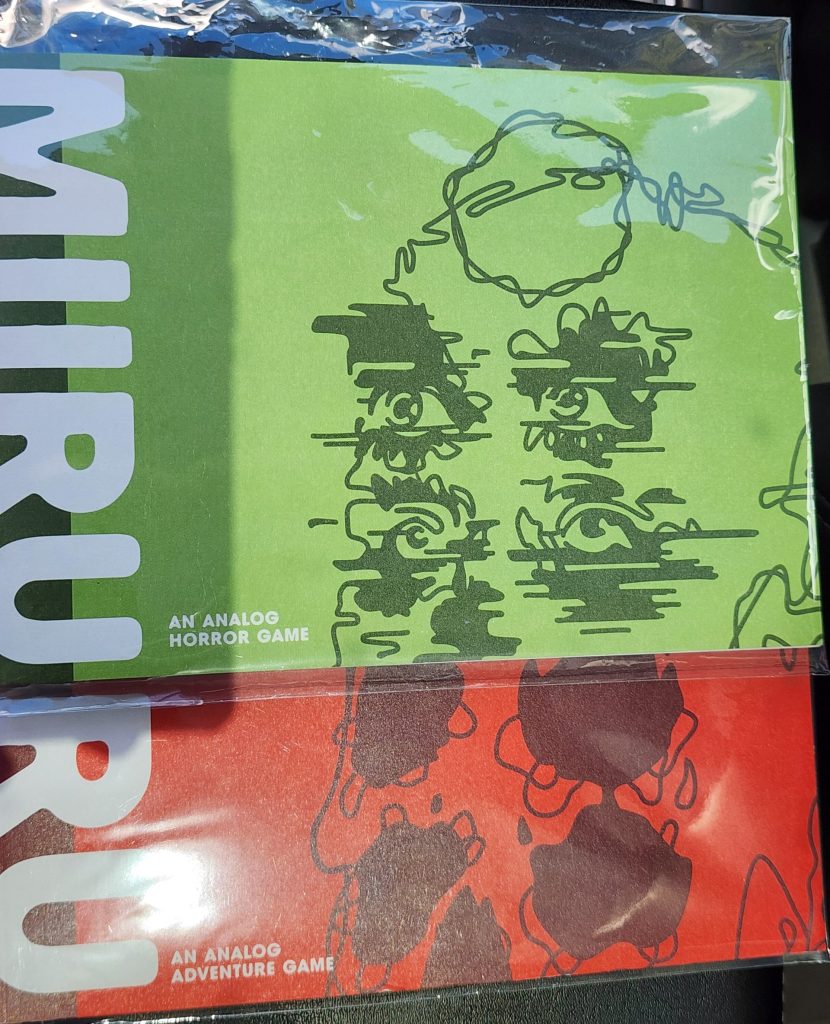
    Two bookletes, one sitting atop the other. The top one is green, with darker green lines making an image of 2 sets of eyes on a face, white text reads "MIIRU" (Miru 2). The bottom one is red, with what looks like part of a skull in darker red, also with 2 sets of eyesockets. The white text on its cover reads MIRU (Miru 1). Both are solo focused analog games.

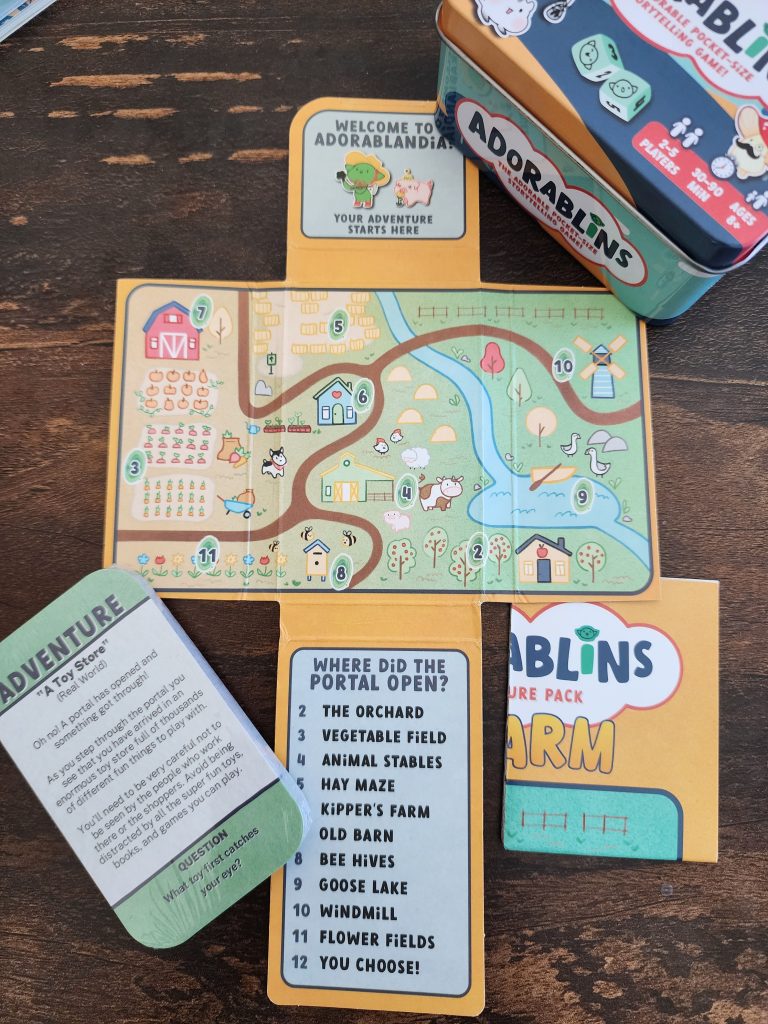
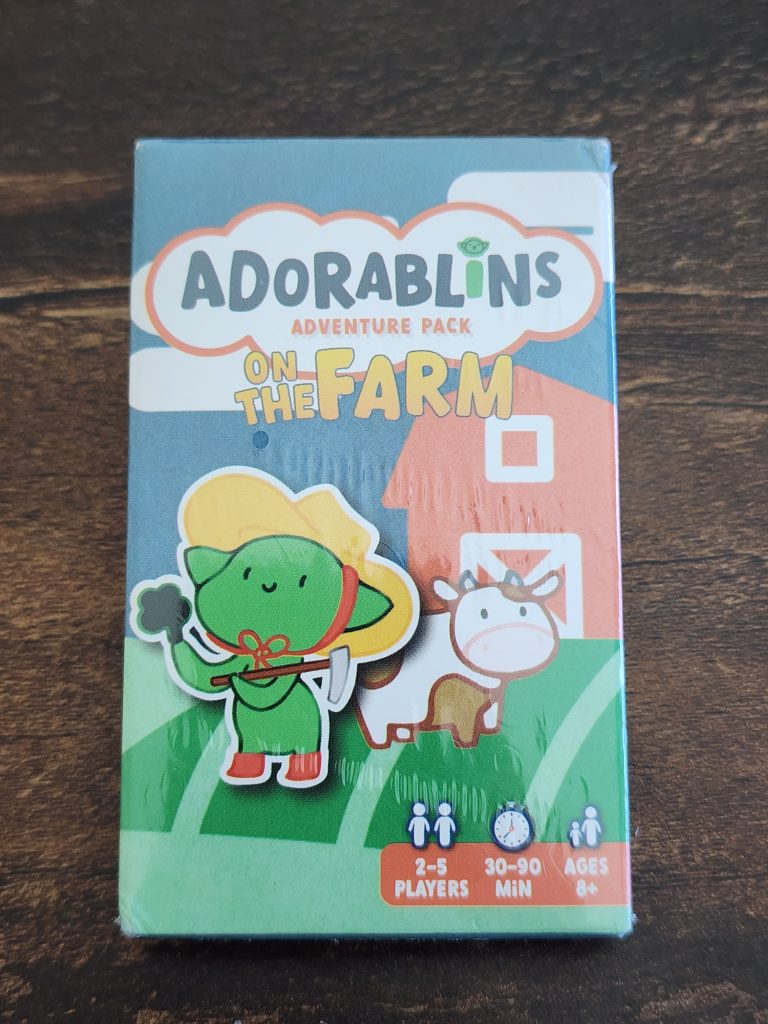
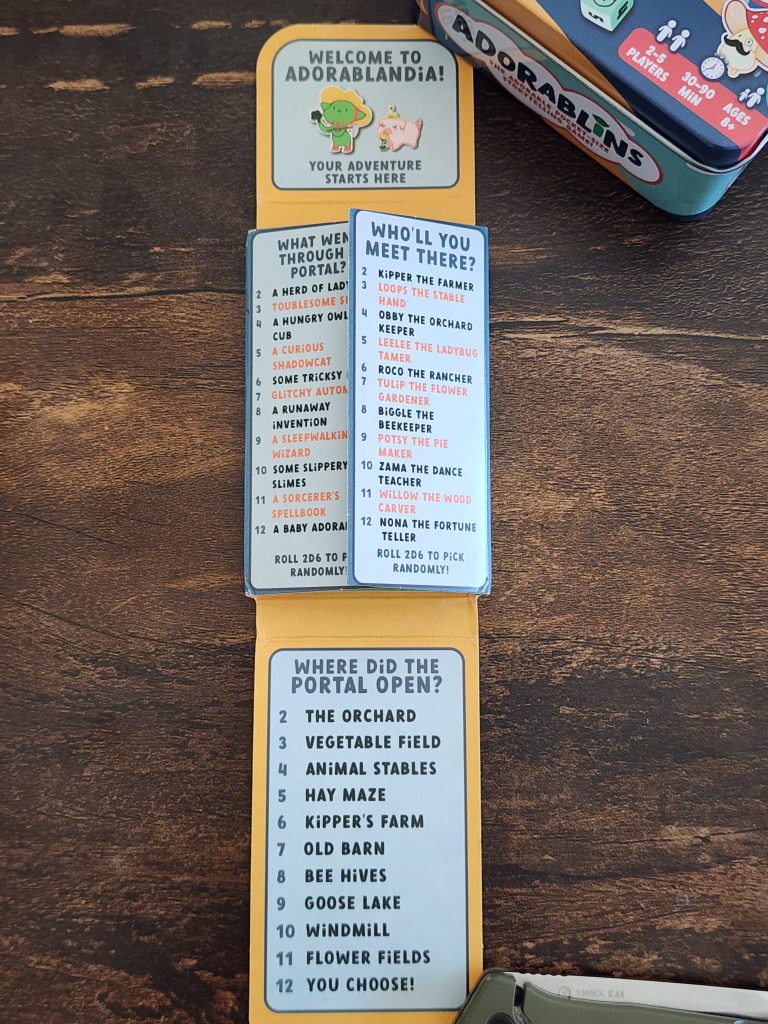
    I picked up a few small additions, including this awesome expansion to Adorablins, which I wrote about previously. I didn’t even know there were expansions to this little mint tin game, but I really enjoy the packaging to it. It’s a great use of the interior flaps of the simple cardboard container to house random tables, and the very inside flaps fold out to a miniature map and locations! Little did I know, this expansion was already part of my tin can version of the game. But it’s OK, I was happy to get this as a reminder to go back and play this game again with my kids (who, like me, are easily distracted when there’s “new shiny things” all the time).
    I was early in the line to get inside and when I got to the register to make my purchase, I took a moment to look over my selection options for the “premium” item choice. After giving the options a look-over, I decided on what looked like one of two remaining Dispel d20’s. Right as I was asking to for it, another gentleman at the register said the same thing (it was a classic jinx moment). Turns out, it was actually the last one, and a tricky box placement that made it look like two. So how did we resolve this conflict? Why, a friendly game of ro-sham-bo of course! We stood in front of one another, eyes locked, the rest of the store watching and counted down, “Ro-Sham-Bo“… as my paper covered his rock, I thanked him for a friendly game and got to take home the last Dispel die. The whole interaction was very friendly and good spirited, which was pleasant to see considering some people can get very touchy about limited items.
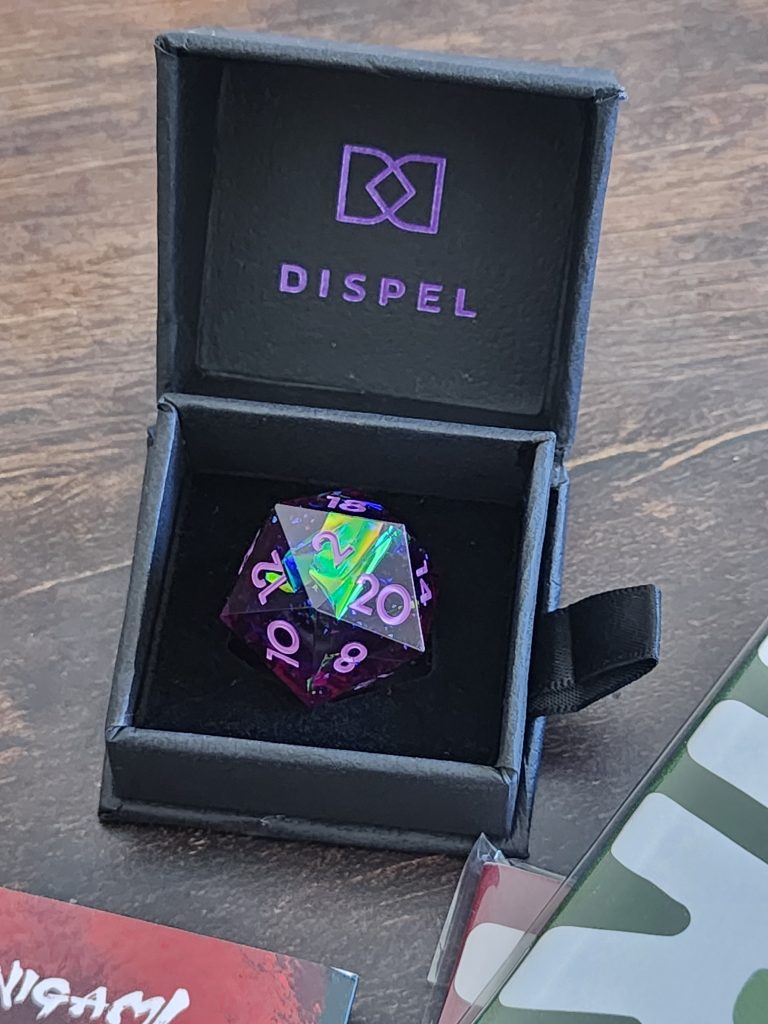
    A small black box sits propped open, holding a single twenty-sided die. The interior lid reads "Dispel". The die sits on a small foam block, its overall colour ranging from ping to purple, with a shining glimmer of blue/green inside. The numbers are painted in pink.

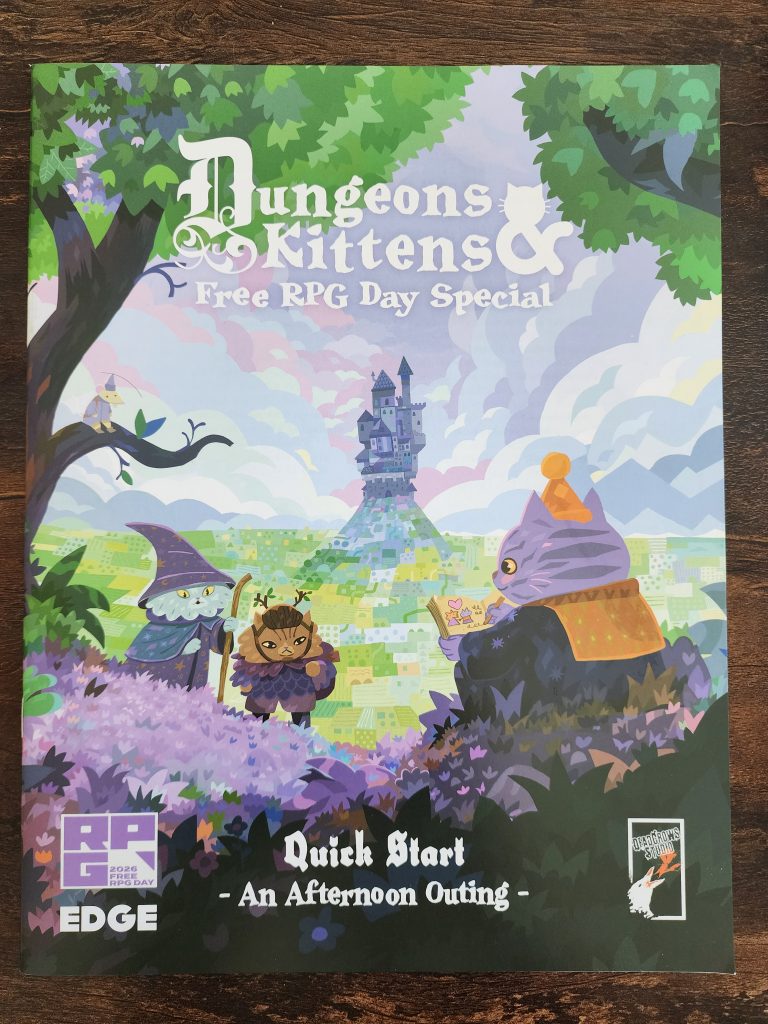
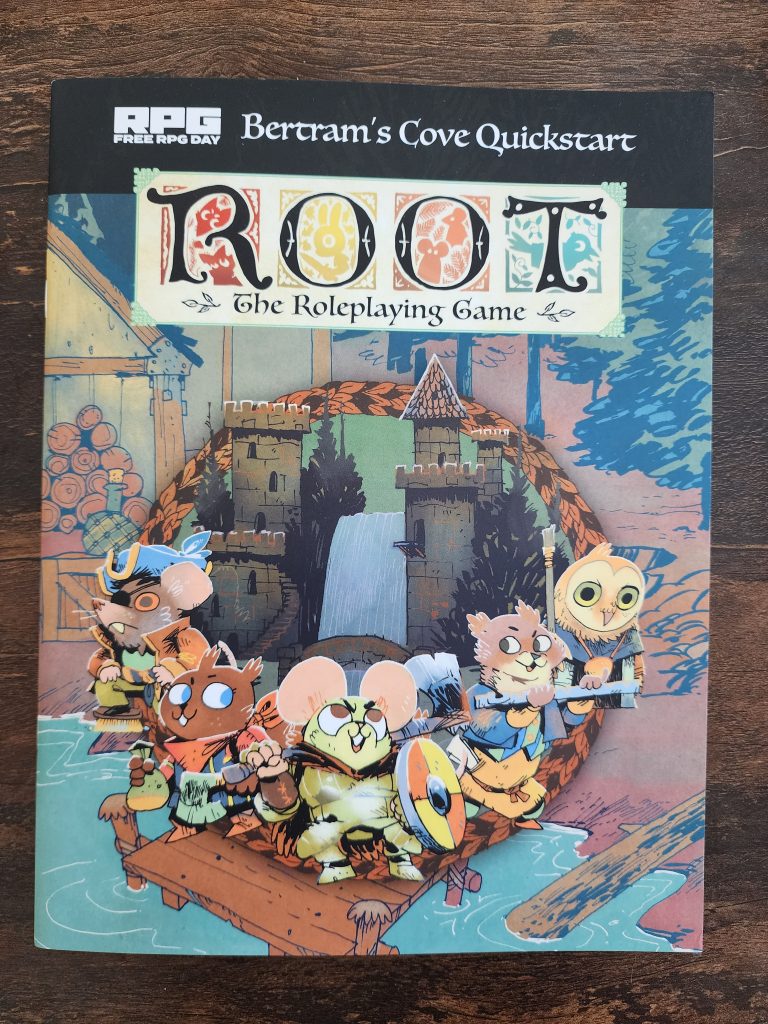
    After that exhilaration, I flipped through several of the FRPGD booklets and chose to take the Pirate Borg Terror in Tortuga quickstart + adventure, the last Root quickstart that I didn’t have from prior years, and the Dungeons & Kittens quickstart + adventure that I thought would be another great game to try with my kids.

    Of course, this post is a few days past FRPGD. Since then, I took a jaunt down to another game shop near my office to check out if they had any leftover goodies they were still looking to get rid of. They did, and I picked up a copy of the CBR+PNK pamphlet Kaguya, as well as a copy of the new Level 1 Anthology, a selection of Indie RPG’s with a central theme (this years being Stand Up!).
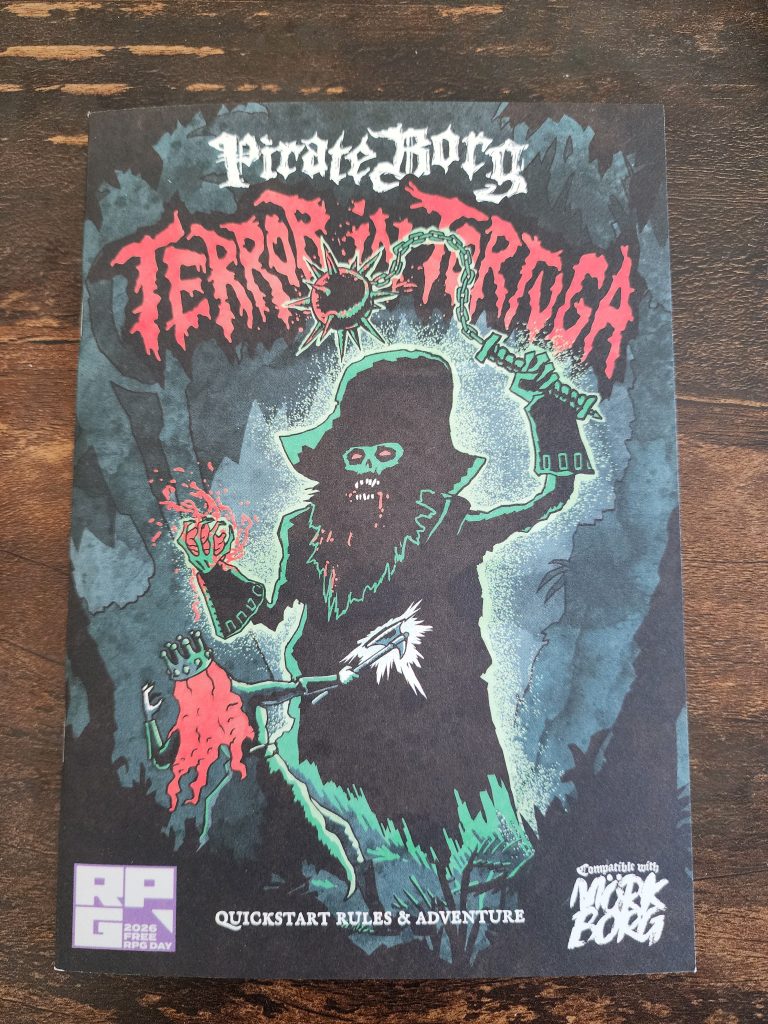
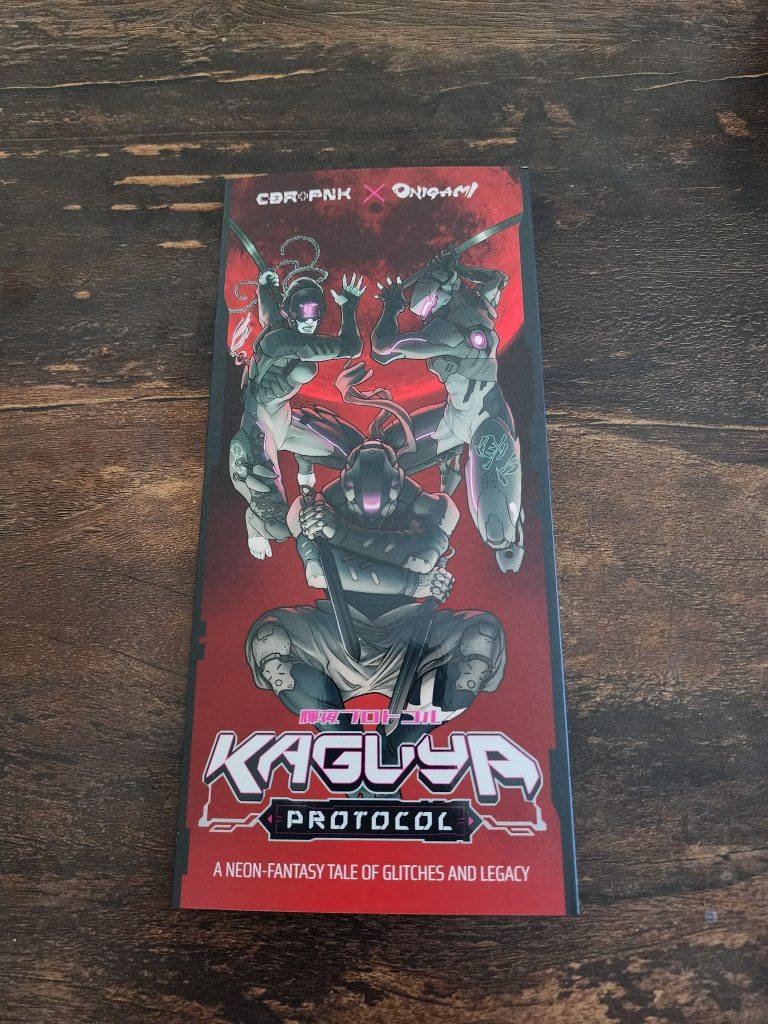
    Overall, I had a great time getting out to a game shop, having a pleasant discussion with one of the staff members about the event, a few RPG systems, and some of the dice selection they had, and getting to play rock paper scissors without one of my kids forcing me to lose.
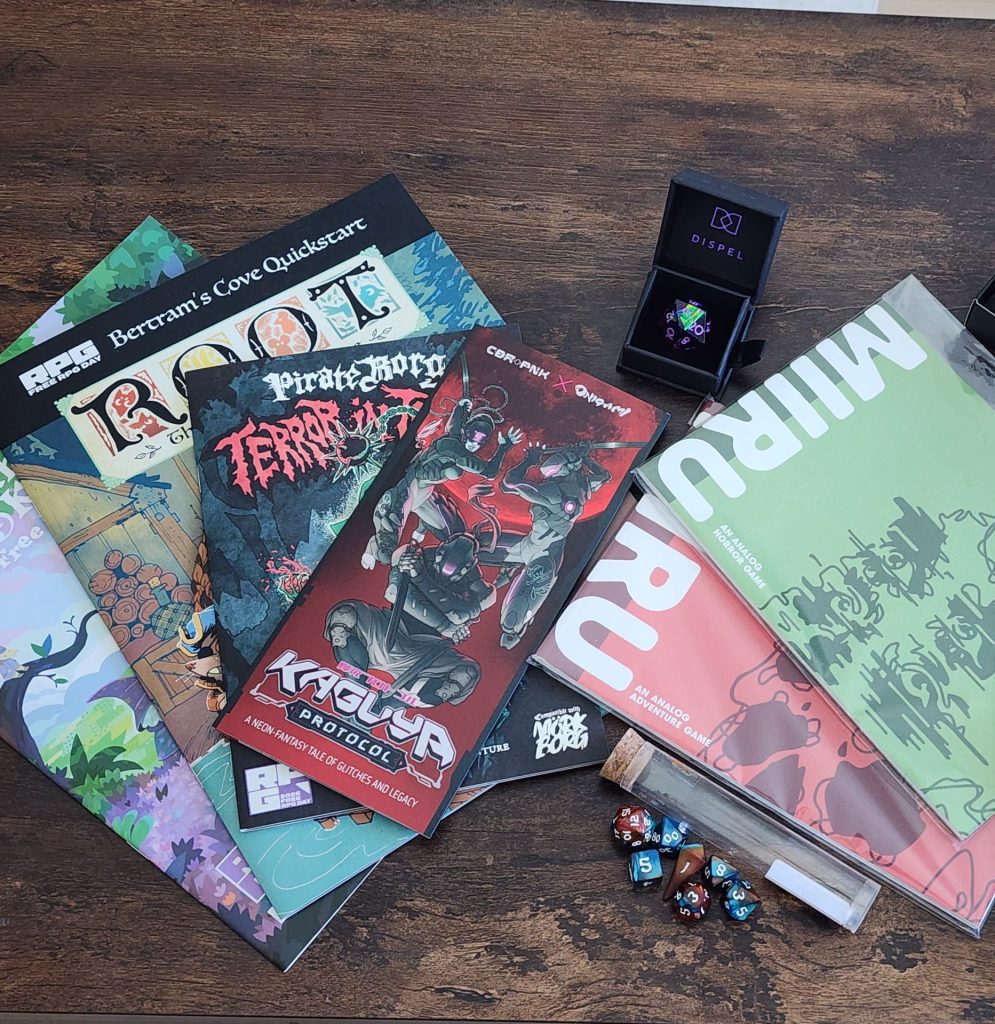
    On a tabletop sits a collection of bookletes (Miru, CBR+PNK Kaguya Protocol, Pirate Borg, Root, Dungeons and Kittens), a D20 die sitting in a small black box, and a short tube next to a set of 7 polyhedral dice. The booklets are spread to show most of their covers, with the dice above and below them.

    Have you been out to any local game shops lately? Perhaps attending a Free RPG Day event? If not, find something close by and maybe you’ll find a system or inspiration for your next Pen & Paper Quest!
  • Adorablins Storytelling Game

    A few weeks back I went to a local discount book store and found a small “mint tin” style game. These are generally small, rules lite games that fit into any variety of small tins, commonly associated to mint tins (in this case think Altoids, but twice as tall).

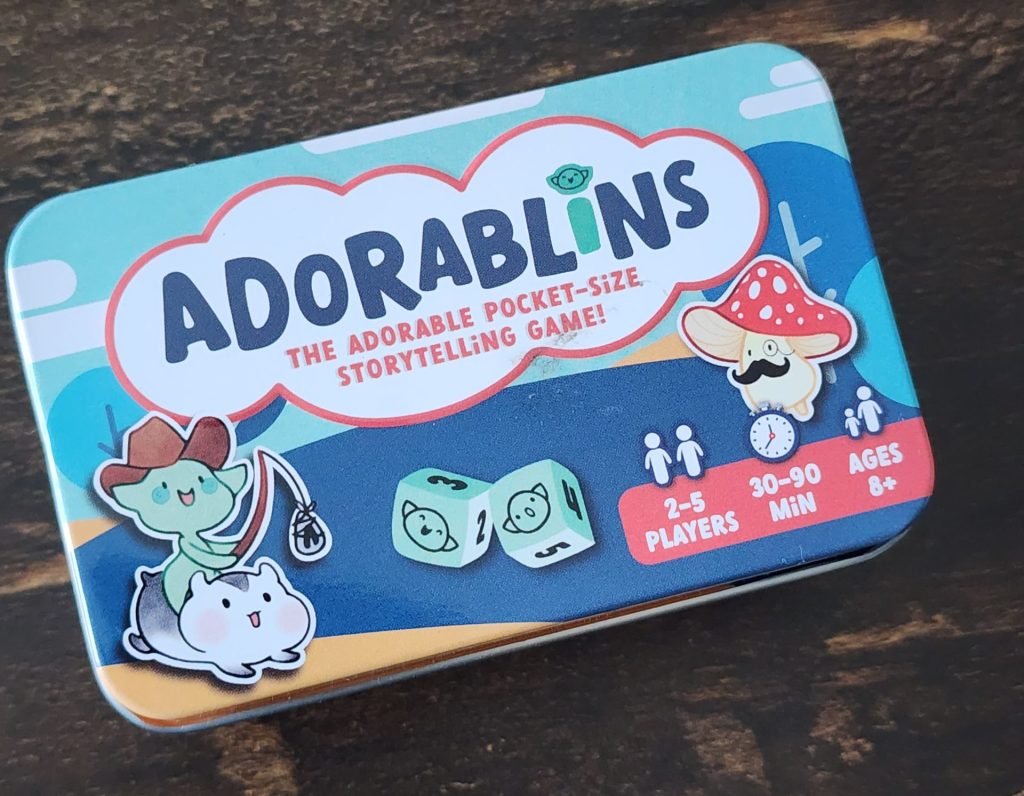
    The top of a small game tin for the game Adorablins. The imagery on the lid shows whimsical art of a small goblin smiling, wearing a cowboy hat, and riding a hamster. A pair of dice with small goblin faces. A mushroom with a monocle and a moustache. It indicates the game is meant for 2-5 players, runs for 30-90 minuets, and is meant for ages 8+. "Adorablins. The adorable pocket-size storytelling game!"

    Adorablins is the game that I had found. I went into it knowing nothing about the game, but the whimsical art style is what caught my eye. After reading the back of the tin, and at only a $7 price tag, I decided to pick it up. It seemed like just the kind of game I could play with my kids – rules light, relatively quick, and built around telling a story, not crunching numbers.

    In Adorablins, play as a super cute goblin-like creature going on endless adventures! This easy-to-learn storytelling game has everything you need to play right in your pocket!

    My first thought was that this would be exactly the sort of simple, guided system that I could get my kids to play. Last week, I had the chance to do just that! After dinner I pulled out Adorablins, spent around 4 minutes looking through the rule booklet and Narrator cards, and dove straight in.

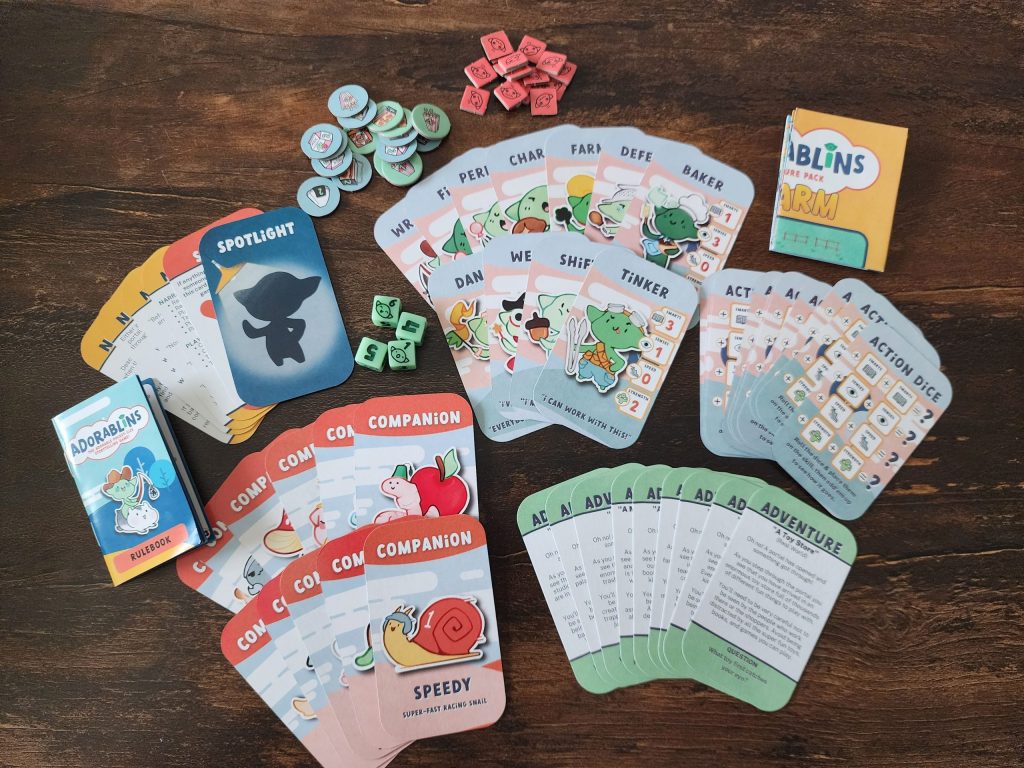
    A tabletop with a variety of cards from the Adorablins game, fanned out, two piles of small chits, a folded paper map, a small rulebook, and a set of four six-sided dice. There are Character cards, each with an image of an adorable goblin with a specific job - Baker, Tinker, Defender, Farmer, etc. Companion cards depicting goblin companions, such as Speedy the racing snail, Wormy the worm, and more. Adventure cards, which detail some pre-made adventures for the Adorablins. A set of Narrator cards, including a spotlight card and an X card. Chits depict a frazzled goblin and a variety of snacks. Action Dice cards indicate how to roll the dice and add them together to determine a result.

    The tin includes 48 cards across 7 types (Characters, Companions, Adventures, Action Cards, Narrator Cards, a Spotlight and Safety Card), a small rule booklet, a folded paper map, two types of chits – snacks and conditions – and four adorable little ~10mm six-sided dice which have tiny goblin heads on the 1 and 6 faces.

    As with most games, you choose one person to be the Narrator, often known as the DM, GM, Judge, Admin, Game Controller – the list goes on. That player will facilitate the gameplay and ensure the story moves along. They read the small rule booklet (~20 pages, 1.5″ x 3″) and once ready, read the Narrator cards out loud.

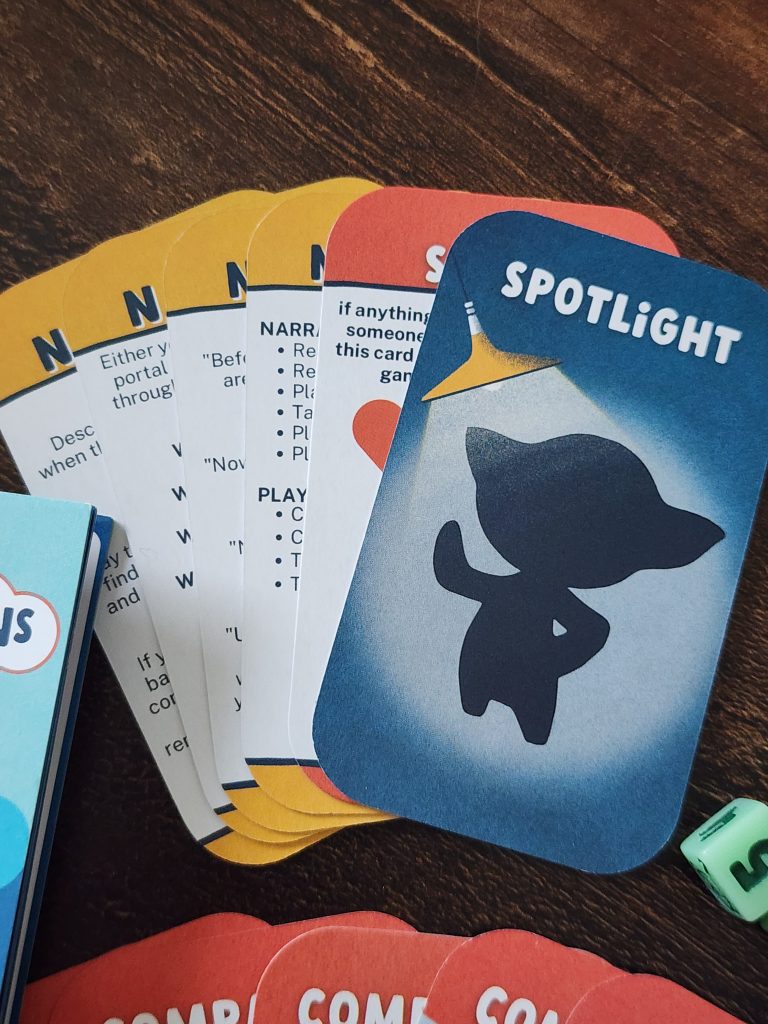
    A set of Narrator cards, with gameplay instructions, a Spotlight card, and a Safety card, with a large red X, from the X-card safety tools.

    Narrator cards have the overall rules and include getting players setup, laying the foundation of the story, and setting the initial scene through a series of questions that everyone can chime in on and answer. There is a Spotlight card, used to give each player a turn in the storytelling, ensuring there’s not a single player who “hogs the limelight.” Then there’s a Safety Card, which has a large red-X on it, often referred to as an X-card. This is an RPG game tool created John Stavropoulos, meant to give players a way to “tap out” of specific topics or events that may come up in a game – no questions asked.

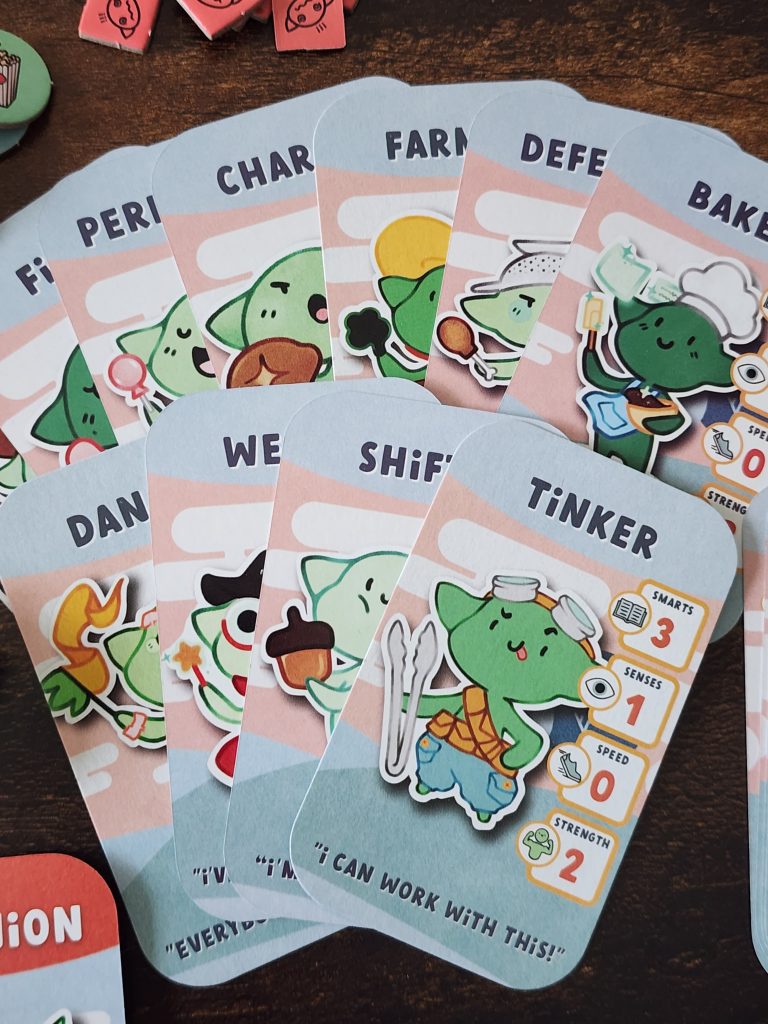
    A closeup of the Adorablin character cards. Each card depicts a whimsical goblin with a specific job - Tinker, Baker, Defender, Farmer, and more. Each chard has a series of stats, including Smarts, Senses, Speed and Strength.

    Character cards depict adorable goblins, each with a specific job and 4 stats – Smarts, Senses, Speed and Strength. On the reverse side of each card is an Ability and Item. For example, the Baker has “Food Magic” which allows them to conjure tasty treats of any flavour, and a “Recipe Book” which has recipes “for any situation.”

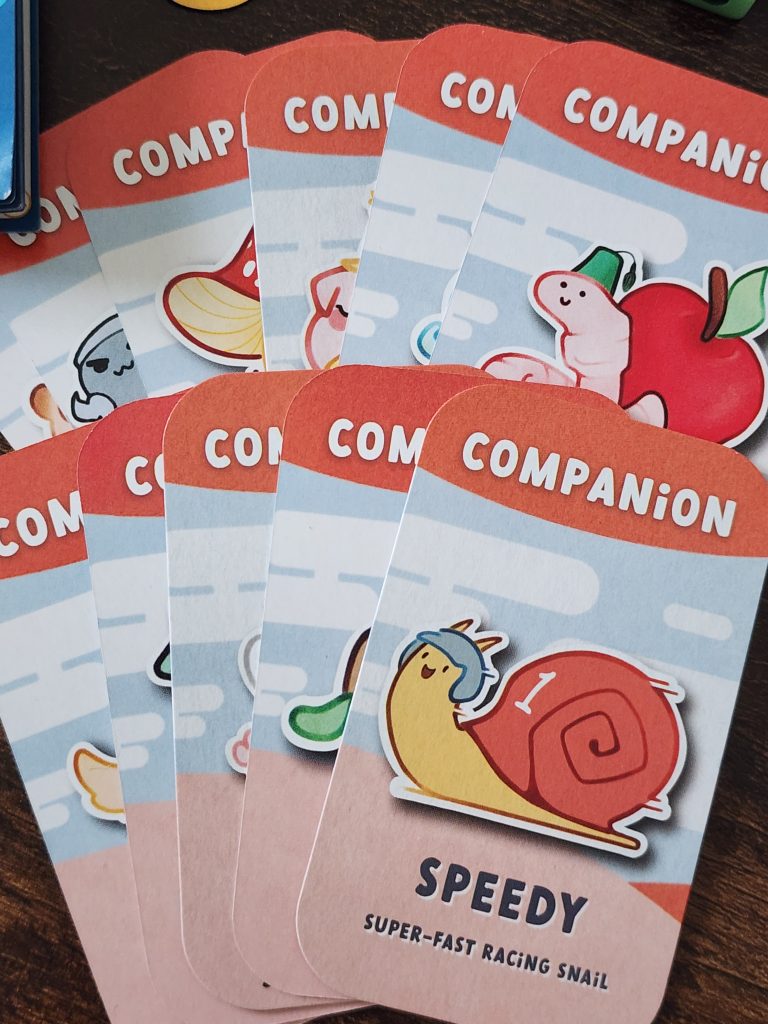
    A spread of Companion cards, each depicting a cartoon-ish entity, that acts as a companion to a goblin. Companions such as Speedy the Super-Fast Racing Snail, Buzzy the Busy Little Bee friend, and Wispy the Elemental Spirit friend.

    Companion cards are simply an image of a variety of companion entities – from Speedy the Super-Fast Racing Snail to Shroomy the Clever Fungus Friend. Companions are used to turn a struggle (failed roll) into a success. Afterwards, they have to be turned over to rest, but it’s OK, they just need a yummy snack to wake them up again!

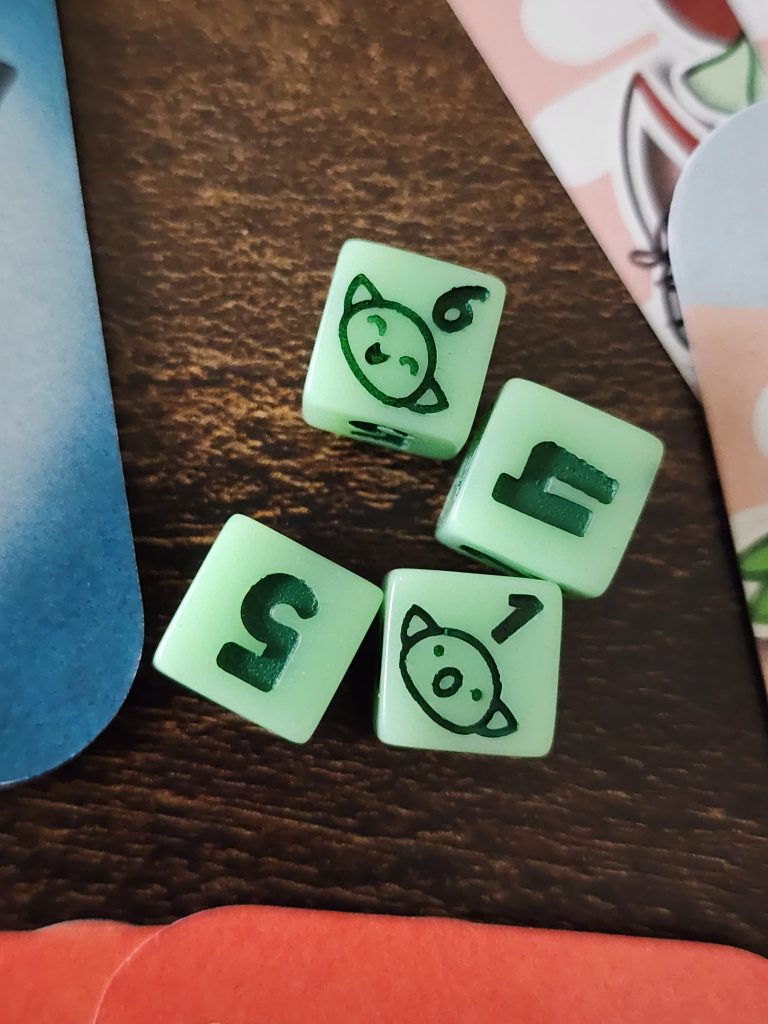
    A zoomed in picture of a set of four, 8mm, 6-sided dice sitting on a tabletop. The dice are a light green colour, the inlaid numbers are a darker shade of green. On the 1's face is a depiction of a small goblin face, mouth agape as if it "failed" at something. On the 6's face is the depiction of a small goblin face, smiling and happy, as if successful in something.
    Goblin math rocks, with actual goblins.

    These dice aren’t quite 10mm in size, but they’re super cute. The 1’s all have a goblin face that has a look of shock on it, as if they just struggled with an important task, while the 6’s all have a smiling, happy goblin who clearly did well.

    I wasn’t sure if my kids would want to play, or what kind of story they would try to come up with, but luckily they were excited to play a game with me even if they didn’t know what it was about. In fact, we ended up playing for nearly an hour and a half! Well past their bedtime when we wrapped up (which I was reminded of with how cranky my youngest became).

    My oldest has a fascination with warriors and fighting bad guys, he chose The Defender, whom he named RJ. I read my youngest several of the character options and he chose The Baker, which he aptly named “The Cooker”.

    To summarize the overall story we ended up narrating together, we started with The Cooker baking chips for RJ The Defender, because he was just out training and worked up quite an appetite. All of a sudden an Inventor burst into the Inn, shouting that a portal had opened near the beehives and his prized painting robot had just wandered into it. Someone had to help get it back!

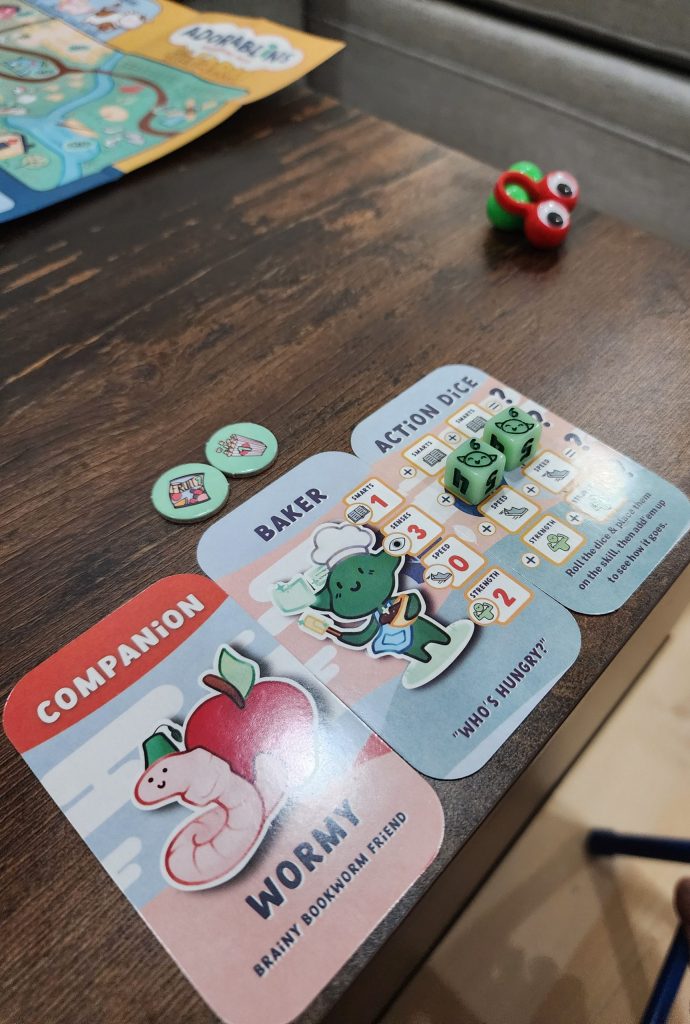
    An image showing part of a tabletop, with a game of Adorablins in session. Three cards sit in a row, the Baker character, Worm companion, and an Action Dice card. Two dice, showing 6's, sit on the action dice card, above the row of cards are 2 "snack" chits. The edge of a paper map is visible in the corner of the image. A set of googly eyes sits near the edge of the table.

    The Cooker and RJ The Defender were immediately onboard, went to the beehives and walked into the portal (which they described as a “wiggly feeling”). The portal sent them to an alien world with large rock formations all around. My youngest rolled a Senses check and right out the gate had double-6’s! Things were looking up as they found the tracks of the robot and started following them.

    After a short exploration through the rocks, they ran into an alien frog! RJ protected The Cooker while he brought out an over-sized spatula and whacked the frog on the head, leaving it dazed, confused, and no longer interested in the two goblins.

    They continued on, until they came across an alien village inhabited by rock people (shoutout to Rocky from Hail Mary, which inspired these rock aliens). One more Senses roll later and The Cooker was laying on the charm, chatting with the village leader until they had a lead on the robot. It was heading towards a plateau overlooking “The Valley of Fire” – a valley full of active volcanoes!

    They headed towards the plateau and saw the painter robot! It was sitting there, frustrated, as it tried to paint the volcanoes, but kept having to start over as lava flows would move and change the scene. Suddenly, a large, 4-winged, bird-like alien flew out of the valley and started to dive for the painting robot!

    RJ rolled a Speed check to run forward and hold up his shield to protect the robot, barely able to push back the alien bird. While RJ continued to defend the robot, The Cooker brought out Wormy, his baking companion, to succeed in a skill check and work on some Food Magic. He conjured up a big, yummy, tasty… buttery bucket of popcorn. This attracted the bird, and gave them a chance to escape, robot in tow.

    At this point I realized it was pretty late, so we sped up the tail end of our adventure by having another Speed check to make sure the goblins could get back to the portal and safely deliver the painter robot back to its inventor. My kids had fun making up a silly story, and being brave little goblins. My youngest even spent the time before bed telling my wife bits and pieces of the story.

    Overall, this was a great game. It has just enough rules to get you going, includes rolling some dice, and keeps everyone involved by having them contribute to the story. Most importantly, I got to spend some time with my kids, and we all used our imaginations to share in a fun experience.

    You could probably take pieces from Adorablins and pair it with bits from other goblin-inspired games, such as Goblin Mail or Goblin Quest, and create your own light-hearted solo RPG system.

    Goes to show that you never know what kind of gems you might uncover for your next Pen & Paper Quest!
  • Creative Rut

    I have been absent updates for longer than intended. I knew going into this that it wouldn’t be an easy task for me, due to a very busy schedule and “real world” priorities. That said, I do want to try and find more time to post here. What complicates that further? Being in a creative rut.

    The end of year / beginning of the year is always a higher stress time for me. With work projects that suddenly have looming “EOY” deadlines, the onset of the dreaded performance review season (which at my work, takes about a month and makes most other things come to a crawl with how involved it is), the it’ll-be-here-before-you-know-it tax season, and the minutiae of day to day life. There’s always a lot going on, and for someone like me, who’s day-to-day workload involves exactly zero creativity, it always pushes me into a creative rut. Fun projects and hobbies get put on the back-burner, and some inevitably sputter out due to other priorities or the fact that I can’t seem to get back into them for months. It has been no different this year, except for even more job-related stress due to uncertainties around employment changes at my office.

    It’s a real shame, too! For several years, February has been a highlight month for TTRPG’s, with (and I admit, there’s too many of these to really keep track now) ZineMo, Zine Month, Zine Quest, Zinetopia, and more. It’s essentially a massive crowdfunding period for all sorts of TTRPG tools, titles and supplements. On one hand, great opportunity for folks who have worked hard to get their dreams out there, and communities to help them turn those ideas into physical and/or digital products. On the other hand, great opportunity for big corporations to capitalize on all that hard work (if you didn’t know, every crowdfunding platform takes a cut of your earnings, on top of payment processor fees, cost of ads you run, and any other platforms you may leverage).

    I haven’t been nearly as active in crowdfunding this year as I have in years past – which, honestly, is a great thing for my wallet, but I have backed a few things which I’ll briefly touch on below. Note, some of these are either already finished crowdfunding or are nearing the end of their campaigns. I am in no way affiliated with any of these projects, these are simply things I decided to spend my own money on. Also, crowdfunding is not a guarantee – it’s a community believing in something, or wanting to see an idea brought into reality – remember this going into it, and be sure whatever you put into a campaign is something you’re ready to write off as soon as you click the button.

    Space Aces: Wreck Runners

    The original Space Aces was a rules lite, Sci-Fi RPG that fit on a business card and used a d20+d6 mechanic. It’s super simple, but has all that you need to run some quick space missions, including simple stats and a mission generator that gets you going with the main objective, location, opposition and a snag to add twists to your game. I really like the Stakes as well, which ask you simple questions about what you’re rolling for – and if there’s nothing risky, uncertain or dangerous, why roll at all? This version of the game is PWYW (Pay What You Want), and even comes with a bunch of additional modules that add more options to a great little game.

    Space Aces: TNG is a revised and expanded version of Space Aces that combines all the modules into a single zine, and has a ton of tables, oracles, generators, and lots of great art. Check out the creators Itch.IO page for even more Space Aces content!

    Space Aces: Wreck Runners is the latest crowdfunding campaign in the series, with a premise of live-streamed exploration of derelict ships in space (i.e.: Wreck Running). There are geomorph tiles to quickly build a starship, with rules to explore it while being live-streamed, to gain loot and glory, and some new mechanics that I’m interested in learning more about once it releases. It promises some wacky, chaotic adventures that I might even be able to convince my kids to play, with the added physical component to build a ship.

    These were all made by Stephen D. of T-Rex games.

    GLIDE: Part Two

    GLIDE, from Sasquatch Games (who also made Zones, a fun STALKER inspired RPG), is another Sci-Fi game, inspired by Frank Herbert’s Dune. It focuses on exploration of a desert planet, where you play a nomad who hopes to help restore the planet back to its original resplendence. I’m a big fan of the simple, effective art pieces throughout the zine, that add to the atmosphere the game sets up. There are a lot of additional expansions for the original game on the Sasquatch Games Itch.IO page as well, such as Relic Hunting and Bounty Hunting.

    GLIDE: Part Two is an expansion of the world of Eridoor (where the original game is set), but doesn’t require the original game to play. It promises to add more tools to build emergent stories, a hex travel system, and deeper character generation. It’s a d10+d6 system, and while I’ve skimmed through the preview of the new rules (which seem pretty complete in all honesty!), I haven’t read through them entirely nor have I sat down to actually play. Overall, it looks like it will turn out to be a fantastic product, with even more great artwork!

    SPACECAT Sci-Fi Adventure RPG

    This looked like an interesting game + comic combo when I stumbled across it. It reminded me of Mausritter (another anthropomorphic animal game that has a vast amount of content out there) and No Mans Sky (the video game) when I first saw it. After reading the 2 sentence blurb at the top of the campaign, I figured I would have to back it.

    A scifi adventure game inspired by Cairn, Into the Odd, and Mausritter. Discover bizarre worlds, fantastical alien creatures, ancient spacecraft, space pirates, and the depths of the unknown.

    The premise is nothing new, you’re a spacefaring animal (OK, maybe that part isn’t too common) who is in major debt and you generate your stories/quests to determine how you’ll pay that debt off (or will you?). It’s a 3-stat system (Strength, Dexterity, Hope), and I’m interested in seeing what sort of tools it incorporates to keep the world expanding and your adventure continuing.

    Depending on the tier you back, it also includes a comic, which looks like it’s based on a long-running webcomic from the creator. I have only looked at the first page posted on Substack, as I want to see the full comic when I receive it post-campaign, but I already enjoy the art style and I’m a sucker for space stories, so I don’t think I’ll be disappointed.

    There are a lot of great looking projects out there, and most, if not all, of the ones that have been funding this month will be available at least digitally (which is great considering the shipping costs of some of the projects, and ongoing concerns around tariffs and imports/exports). A lot of creators have Itch.IO pages, or their own web shops, for you to go explore as well!

    Hopefully everyone else is have more creative inspiration than I have been, and if you haven’t checked out any new games lately, go see what else is out there for your next Pen and Paper Quest!

    P.S.: If you ever back a crowdfunded campaign that doesn’t fulfill, remember there are real people behind those projects. It’s frustrating, sure, but be kind. Those people are probably also disappointed and going through their own challenges. I’ve backed my fair share of projects, and I can count on two hands the number of campaigns that never fulfilled, and on one hand the number that ended up being actual scams. It’s a small number in the grand scheme of things and not worth the wasted energy.

  • Korg – Simple, Solo, Dungeon Crawling

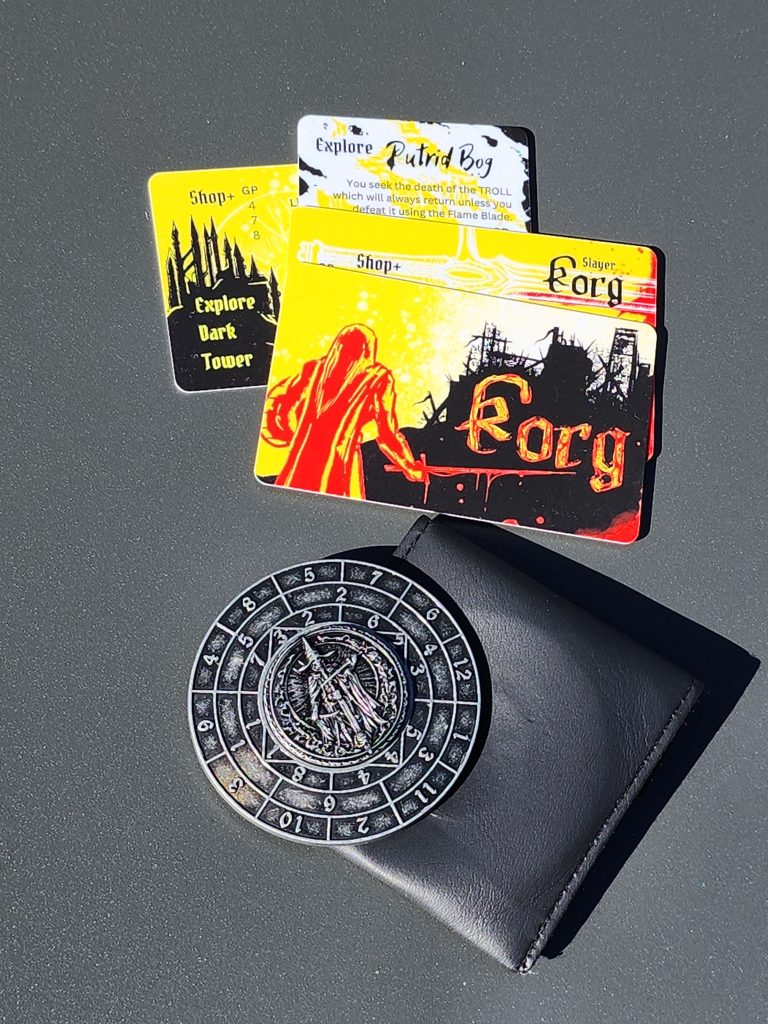
    If you recall from my last post, one of the items in my EDC RPG kit is a credit-card sized game called “Korg”. This is a quick, easy, dungeon crawling game in a portable format that allows you to play a quick RPG on the go. Originally Kickstarted by Caleb Engelke (also known as Dungeon Havoc) back in December of 2022, the campaign raised over $17,000 dollars (!) for the first iteration of Korg.

    The primary goal of the game is to collect a set amount of “GP” (gold pieces), by defeating monsters in a dungeon. Once you reach that goal, you get to retire! The gameplay loop is also simple, making it easy to pickup and play wherever you are. You just roll a d6 (6-sided die), the number corresponds to what you encounter in the dungeon, then roll over that foes target number. If you win you get GP, if you lose you take damage. Lose all your health, and you have to start over. There are additional cards with a Shop, which lets you buy your choice of several items to help heal you, reduce damage you take, and more.

    The simplicity of the game also lends to its ability to be expanded on. If you wanted to create an in depth character with a complete backstory, and place the dungeon in a world you start building, you can do that! Maybe you want to add a few new rules, while keeping the same core loop, that’s also possible!

    Korg did well enough that Caleb eventually created a new crowdfunding campaign to fund Korg Slayer, new expansion cards to add additional locations and foes to fight, in the world of Korg. These include the Putrid Bog, Dragon’s Lair, and Tyrant’s Keep – and of course, new shop items to help you along the way as well.

    Since then, there have been other additions to the Korg lineup as well, with CY//Korg, Scars of Silvos, and Classic Korg v.1 (a remastering of this original Korg, with some new locations and quests). I still enjoy my copy of the original Korg and Slayer expansions, because none of the new ones have been printed in a durable format like these ones (though that didn’t stop me from backing all the other campaigns…).

    My main draw to this game, when I first saw it, was the format. A durable, portable game that could be played whenever I had downtime, and would last longer than something I print out myself. I pair it with a small dice spinner (effectively a ball bearing with a bunch of number rings to indicate different die types – d4, d6, d8, d10, d12, d20), which is usually with me all the time anyway, and it makes it pretty easy to pull out and play a few quick rounds.

    This is also a game that I can take out and play with my kids. It’s actually a great introduction to RPG’s, but it’s also a great reinforcement for my sons math classes, where he’s learning addition and subtraction. He also has to learn about making choices – when to spend that hard earned GP on a potion to heal (or risk death on the next dungeon roll), or even some upgrades like armor, to absorb some of the damage he might take. We can also come up with stories about the encounters we roll, change the monsters (a Skeleton might become a Goblin or a Wolf), and try to figure out why we’re trying to collect all that gold in the first place!

    So if you need a simple game to take with you on the go, or want to find something that you can teach to younger children, take a look at the Korg games for your next Pen & Paper Quest!


    P.S.: I am unaffiliated with any of the platforms or folks mentioned in this post, I’m just sharing them so that others can find out more about them.

    While I don’t think you can get this copy of the original Korg any longer, Korg Classic v.1 is the same content (and more!), just printed as standard playing cards (definitely sleeve them!). You can find them on the Dungeon Havoc Ko-Fi page.